
Introduction
A few years ago, I came across a fascinating case study where engineers tested a car’s safety—without crashing a single real vehicle. That was my first real exposure to computer simulation technology, and it completely changed how I understood modern innovation.
Today, from predicting pandemics to designing aircraft and even studying black holes, simulations are everywhere. They quietly power decisions behind the scenes, saving time, money, and sometimes even lives.
In this guide, I’ll break down what computer simulation technology really is, how it works, its types, and how it’s used across industries, with simple explanations and practical examples.
Overview
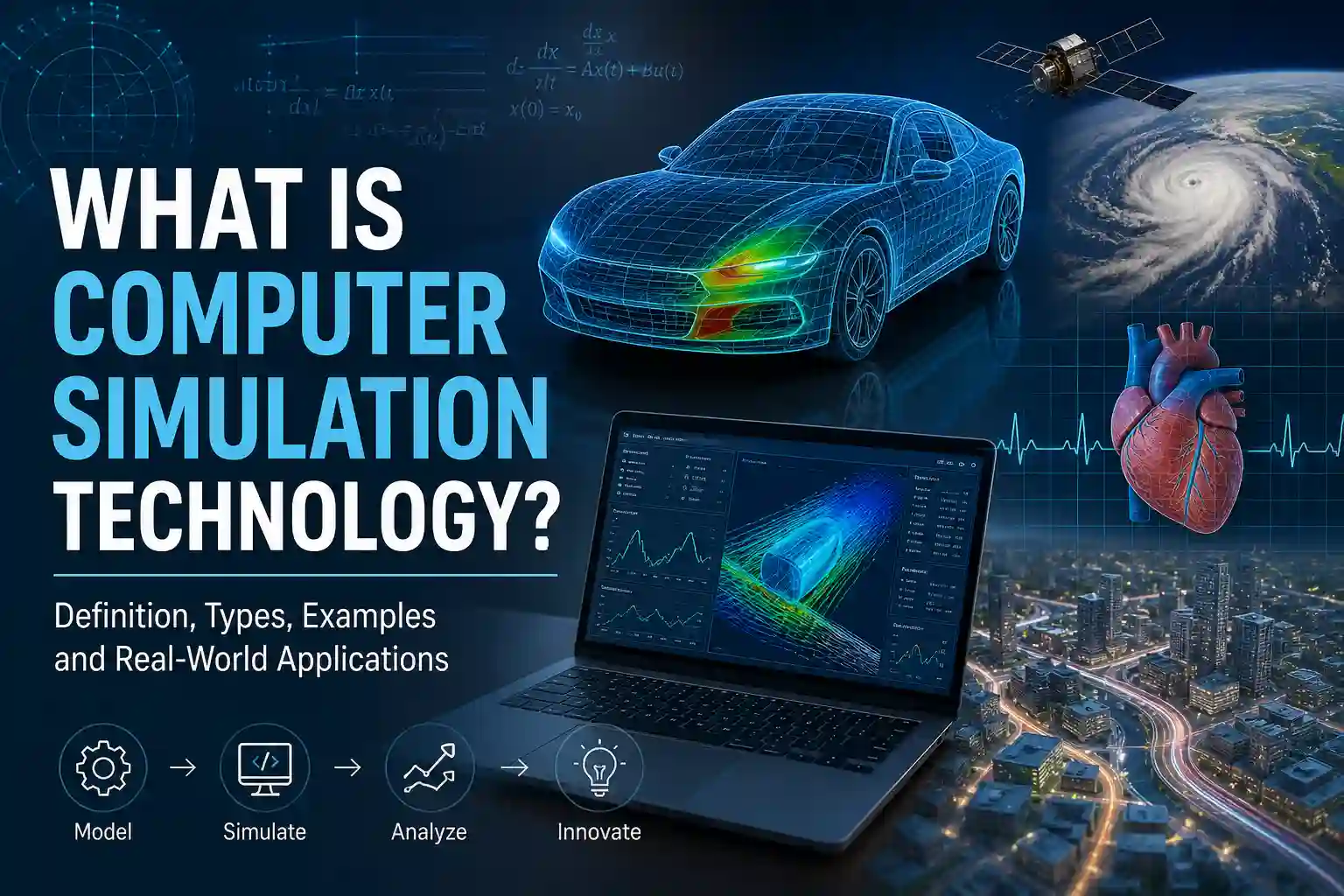
Computer simulation technology uses mathematical models, algorithms, and software to create digital representations of real-world or hypothetical systems, predicting their behavior and performance over time. It enables cost-effective testing and experimentation in fields like engineering, meteorology, and medicine without building physical prototypes.
Key Aspects of Computer Simulation Technology
Function:
It is used for prediction, understanding, and exploration, allowing researchers to simulate scenarios that are too dangerous, expensive, or complex to test in reality.
Types of Simulations:
- Continuous: Models systems that change continuously over time (e.g., weather patterns).
- Discrete: Models systems that change only at specific points in time (e.g., traffic flow).
- Monte Carlo: Uses random sampling to simulate probabilities and risks.
- Agent-Based: Models the actions of individuals to study system-wide effects.
Common Applications:
- Engineering & Manufacturing: Digital prototyping and design optimization
- Science & Medicine: Climate modeling, molecular research, surgical simulations
- Training & Entertainment: Flight simulators and gaming physics
Key Features:
Modern simulation software includes 3D visualization, animation, and automated data analysis.
Read More About: What Technology Innovations Happened in California
What Is Computer Simulation Technology?
In simple terms, computer simulation technology is the process of using computers to create a digital version of a real-world system and test how it behaves under different conditions.
Simple Definition
A computer simulation is a program that models real-life situations using mathematical equations and algorithms.
Technical Perspective
It combines:
- Mathematical modeling
- Algorithms
- Data analysis
- Computational power
to replicate real-world behavior in a controlled virtual environment.
Why It Matters
From my experience, the biggest advantage is this:
👉 You can test ideas without real-world risk.
For example:
- Car manufacturers simulate crashes instead of destroying real cars
- Scientists simulate disease spread instead of waiting for real outbreaks
- Meteorologists simulate weather before it happens
How Computer Simulations Work (Step-by-Step)
When I first tried to understand simulations, I realized they follow a clear logical process.
1. Build a Mathematical Model
Everything starts with equations that represent the system.
Example:
- Speed, force, and impact for a car crash
- Temperature, pressure, and wind for weather models
2. Define Variables
These are the inputs that can change.
Examples:
- Weather conditions
- Population density
- Material strength
3. Create an Algorithm
The system uses algorithms to process variables and predict outcomes.
4. Run the Simulation Over Time
The system calculates results step-by-step:
- Time t → t+1 → t+2
This allows dynamic changes.
5. Analyze Results
The output is converted into:
- Graphs
- Visualizations
- Large datasets
This is where real insights come from.
Types of Computer Simulations
One major gap I noticed in many articles is the lack of clarity around simulation types. Understanding this makes everything easier.
1. Continuous Simulation
- Models systems that change constantly
- Example: Weather forecasting, climate modeling
2. Discrete Event Simulation
- Models events happening at specific times
- Example: Traffic systems, supply chains
3. Monte Carlo Simulation
- Uses randomness to predict outcomes
- Example: Financial risk analysis
4. Agent-Based Simulation
- Models behavior of individuals (agents)
- Example: Disease spread, social behavior
This is widely used in research like pandemic modeling.
5. Dynamic Simulation
- Focuses on systems changing over time
- Example: Economic systems, ecosystems
6. Hybrid Simulation
- Combines multiple approaches
- Used in complex industries like aerospace
Real-World Examples of Computer Simulation
Here are some of the most interesting applications I’ve studied:
1. Car Crash Testing
Instead of crashing real cars, companies simulate:
- Impact forces
- Passenger safety
- Structural damage
2. Pandemic Prediction
Simulations helped model diseases like Ebola and COVID-19:
- Predict spread
- Test interventions
- Plan healthcare responses
3. Cancer Treatment
Researchers simulate how tumors respond to drugs, improving treatment strategies.
4. Weather Forecasting
Tools like WRF models simulate:
- Rainfall
- Temperature
- Storm patterns
5. Earthquake Analysis
Scientists simulate earthquakes to understand:
- Tsunami risks
- Structural damage
6. Black Hole Research
NASA uses simulations to study:
- Hawking radiation
- Cosmic behavior
7. Air Quality Prediction
Simulating smoke from wildfires helps predict pollution levels.
Applications Across Industries
What surprised me most is how widely simulations are used.
Healthcare
- Disease modeling
- Drug testing
- Surgical simulations
Engineering & Manufacturing
- Product design
- Stress testing
- Digital twins
Finance
- Risk modeling
- Market prediction
Aerospace
- Flight simulations
- Aircraft design
Climate Science
- Weather forecasting
- Climate change prediction
Supply Chain & Logistics
- Inventory optimization
- Delivery systems
Benefits of Computer Simulation Technology
From everything I’ve seen, these are the biggest advantages:
- Saves cost (no physical prototypes)
- Reduces risk
- Speeds up innovation
- Allows testing of extreme scenarios
- Improves decision-making
Limitations You Should Know
Simulations aren’t perfect.
Here are some real challenges:
- Dependence on accurate data
- Wrong assumptions can mislead results
- High computational cost
- Requires expertise
A famous example is the 2008 financial crisis, where flawed models contributed to major failures.
Popular Computer Simulation Software
Some widely used tools include:
- MATLAB Simulink
- AnyLogic
- ANSYS
- COMSOL
- Arena Simulation
- SimScale
Each is used for different industries and complexity levels.
Computer Simulation vs Modeling
This confused me at first, so here’s a simple distinction:
- Modeling: Creating the mathematical representation
- Simulation: Running experiments using that model
Think of modeling as building the engine, and simulation as driving the car.
Future of Computer Simulation Technology
The future looks incredibly exciting.
Key Trends I’m Watching
- AI-powered simulations
- Digital twins of real-world systems
- Quantum computing simulations
- Personalized medicine simulations
- Faster molecular modeling
Imagine testing millions of treatments on a virtual human before real treatment begins—that’s already becoming reality.
Practical Tips: How to Start Learning Simulation
If you’re new, here’s what I recommend:
- Start with basic modeling concepts
- Learn tools like MATLAB or Python
- Practice with small simulations (traffic, weather)
- Study real-world case studies
- Focus on one industry first
Conclusion
Computer simulation technology is no longer just a scientific tool—it’s a decision-making powerhouse shaping industries worldwide.
From predicting disasters to designing life-saving treatments, simulations allow us to explore possibilities without real-world consequences.
If there’s one key takeaway from my experience, it’s this:
👉 The better we simulate reality, the better we can shape the future.
Whether you’re a student, professional, or business owner, understanding simulations gives you a powerful advantage in today’s data-driven world.