
Take a moment and look around. The smartphone in your hand, the car on the road, the packaged food in your kitchen, and even the electricity powering your home all have one thing in common: industrial technology played a role in making them possible.
I remember visiting a modern manufacturing facility for the first time. I expected to see workers manually assembling products from start to finish. Instead, I saw robots moving with incredible precision, automated systems tracking inventory in real time, and computers controlling entire production lines. It felt less like a traditional factory and more like stepping into the future.
That experience made me realize how much industrial technology has evolved—and how important it has become in nearly every industry.
In this guide, I’ll explain what industrial technology is, how it works, where it’s used, its benefits and challenges, and why it’s shaping the future of manufacturing, engineering, and business.
What Is Industrial Technology?
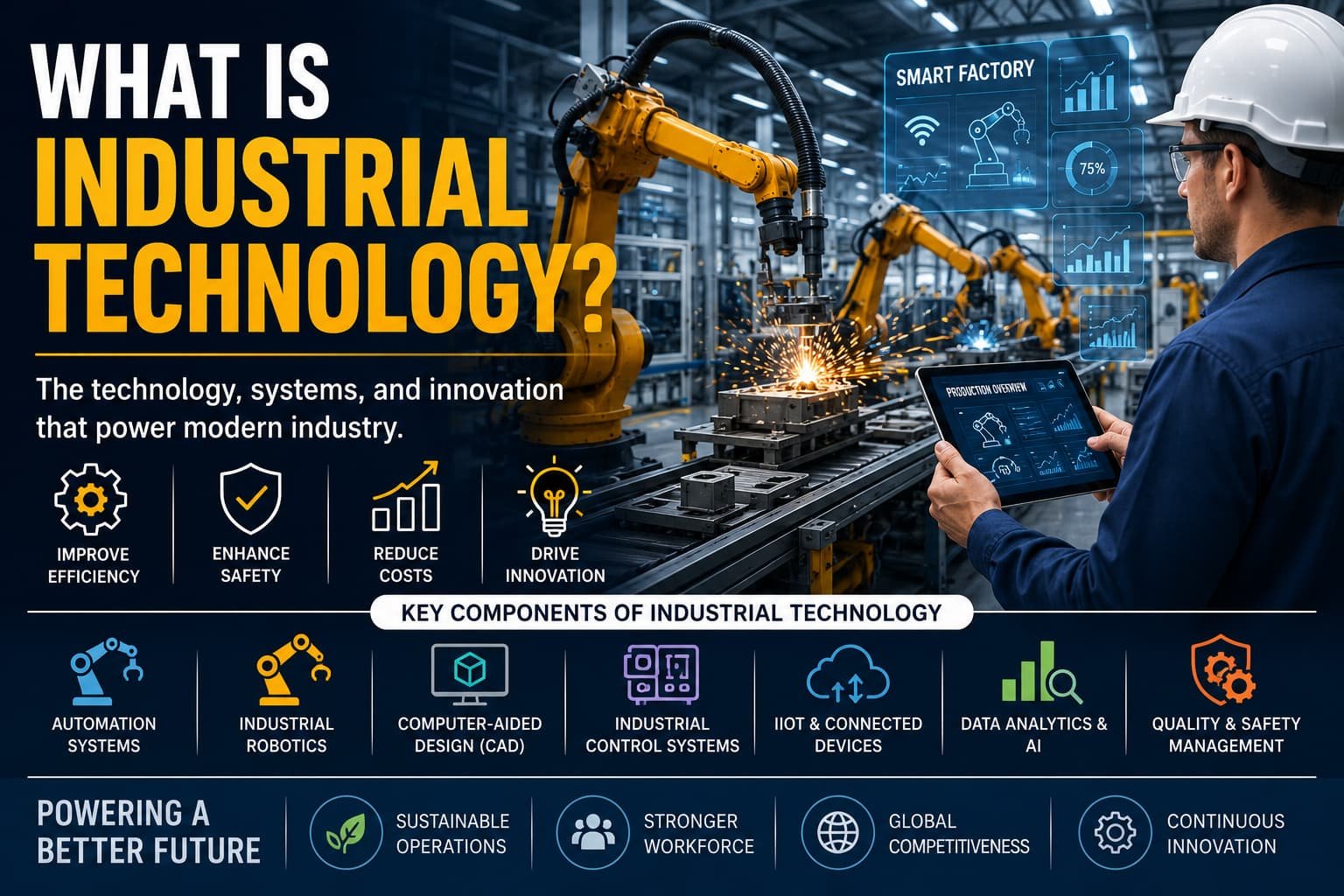
Industrial technology refers to the use of engineering, machines, automation, software, and technical systems to improve industrial processes, manufacturing operations, production efficiency, and product quality.
Simply put, industrial technology helps businesses produce goods and services faster, safer, and more efficiently.
It combines multiple disciplines, including:
- Engineering
- Manufacturing
- Automation
- Computer systems
- Robotics
- Quality control
- Supply chain management
The goal is to optimize how products are designed, produced, tested, and delivered.
See More: How Does Technology Improve Our Lives?
A Simple Definition
If traditional manufacturing is about making products, industrial technology is about making the process of making products smarter.
This includes everything from automated assembly lines to artificial intelligence-powered quality inspections.
Why Industrial Technology Matters
Without industrial technology, modern economies would struggle to meet demand for products and services.
Think about industries such as:
- Automotive manufacturing
- Electronics production
- Aerospace engineering
- Food processing
- Healthcare equipment manufacturing
- Energy production
These sectors rely heavily on advanced technologies to remain competitive.
The Main Objectives of Industrial Technology
Industrial technology helps organizations:
- Increase productivity
- Improve product quality
- Reduce production costs
- Enhance workplace safety
- Minimize waste
- Improve sustainability
- Speed up innovation
In my experience researching manufacturing trends, companies that invest in industrial technology often gain significant advantages over competitors that rely solely on traditional methods.
The Evolution of Industrial Technology
To understand today’s industrial systems, it’s helpful to look at how we got here.
The First Industrial Revolution
The first industrial revolution introduced:
- Steam engines
- Mechanized production
- Textile machinery
This transformed manual labor into machine-assisted production.
The Second Industrial Revolution
This era introduced:
- Electricity
- Mass production
- Assembly lines
Manufacturing became faster and more scalable.
The Third Industrial Revolution
Computers changed everything.
Businesses adopted:
- Computer-aided design (CAD)
- Automation systems
- Digital controls
Production became more accurate and efficient.
Industry 4.0: The Current Era
Today, we are experiencing Industry 4.0.
This modern phase includes:
- Artificial intelligence (AI)
- Internet of Things (IoT)
- Robotics
- Big data analytics
- Cloud computing
- Smart factories
Machines can now communicate with one another and make data-driven decisions in real time.
Key Components of Industrial Technology
Industrial technology consists of several interconnected systems.
Automation Systems
Automation reduces the need for repetitive manual tasks.
Examples include:
- Conveyor systems
- Packaging machines
- Automated assembly lines
Automation helps increase speed and consistency.
Real-World Example
Automotive manufacturers such as Toyota and Ford Motor Company use automated robotic systems to assemble vehicle components with remarkable precision.
Industrial Robotics
Robots have become essential in modern manufacturing.
Common tasks include:
- Welding
- Painting
- Packaging
- Material handling
- Product inspection
I was surprised by how advanced industrial robots have become. Some systems can work continuously for hours while maintaining an extremely high level of accuracy.
Computer-Aided Design (CAD)
CAD software helps engineers design products digitally before manufacturing begins.
Popular CAD tools include:
- AutoCAD
- SolidWorks
- CATIA
These tools reduce errors and accelerate product development.
Industrial Control Systems
Industrial control systems monitor and manage production equipment.
Examples include:
- PLCs (Programmable Logic Controllers)
- SCADA systems
- Distributed control systems
These technologies ensure machines operate safely and efficiently.
How Industrial Technology Works in Manufacturing
Modern production facilities rely on integrated technology systems.
A typical workflow may include:
Step 1: Product Design
Engineers create digital product models using CAD software.
Step 2: Production Planning
Software calculates:
- Materials needed
- Production schedules
- Labor requirements
Step 3: Automated Manufacturing
Machines and robots perform production tasks with minimal human intervention.
Step 4: Quality Control
Sensors and AI systems inspect products for defects.
Step 5: Logistics and Distribution
Technology tracks inventory and coordinates shipments.
The entire process becomes faster, more accurate, and easier to manage.
Applications of Industrial Technology
Industrial technology extends far beyond factories.
Manufacturing
Manufacturers use technology for:
- Production automation
- Quality assurance
- Inventory management
Healthcare
Healthcare organizations use industrial technology to produce:
- Medical devices
- Surgical equipment
- Diagnostic tools
Energy Sector
Power plants utilize advanced control systems to optimize energy generation.
Food and Beverage Industry
Food manufacturers rely on automation for:
- Packaging
- Processing
- Safety inspections
Aerospace
Aircraft manufacturers use advanced engineering technologies to build safer and more efficient aircraft.
Benefits of Industrial Technology
Industrial technology delivers numerous advantages.
Increased Efficiency
Machines perform repetitive tasks faster than humans.
Better Product Quality
Automation reduces human error and improves consistency.
Improved Safety
Dangerous tasks can be assigned to machines instead of workers.
Cost Reduction
Higher efficiency often lowers production costs over time.
Faster Innovation
Companies can develop and launch products more quickly.
What I found particularly interesting is how technology often improves both productivity and quality at the same time—a combination that businesses constantly seek.
Challenges of Industrial Technology
Despite its benefits, industrial technology also presents challenges.
High Initial Costs
Advanced equipment and software can require significant investment.
Workforce Training
Employees must learn how to operate and maintain new systems.
Cybersecurity Risks
Connected industrial systems may become targets for cyberattacks.
System Maintenance
Technology requires ongoing updates and maintenance.
Organizations must balance these challenges with the long-term benefits.
The Future of Industrial Technology
Industrial technology continues evolving rapidly.
Several trends are shaping the future.
Artificial Intelligence
AI is helping manufacturers:
- Predict equipment failures
- Optimize production schedules
- Improve quality control
Smart Factories
Smart factories use connected devices and real-time data to improve operations.
Digital Twins
Digital twins create virtual models of physical equipment, allowing companies to test changes before implementing them.
Sustainable Manufacturing
Many organizations are using technology to:
- Reduce waste
- Improve energy efficiency
- Lower environmental impact
These innovations are making industries more productive and sustainable.
Skills Needed for a Career in Industrial Technology
If you’re interested in this field, valuable skills include:
- Problem-solving
- Engineering fundamentals
- Data analysis
- Computer systems knowledge
- Automation technology
- Robotics
- Project management
The demand for skilled professionals continues to grow as industries become more technology-driven.
Quick Takeaways
If you’re short on time, remember these key points:
- Industrial technology improves manufacturing and production processes.
- It combines automation, engineering, software, and data systems.
- Modern industries rely heavily on industrial technology.
- Industry 4.0 is driving smart factories and connected systems.
- AI, robotics, and IoT are shaping the future of industrial operations.
Frequently Asked Questions
What is industrial technology in simple terms?
Industrial technology is the use of machines, automation, engineering, and software to improve how products are designed, manufactured, and delivered.
What industries use industrial technology?
Manufacturing, healthcare, automotive, aerospace, energy, logistics, and food processing industries all rely heavily on industrial technology.
Is industrial technology a good career field?
Yes. Industrial technology offers strong career opportunities in engineering, automation, robotics, manufacturing management, and industrial operations.
Conclusion
Industrial technology is one of the driving forces behind modern industry. From automated assembly lines and robotics to AI-powered quality control and smart factories, it helps businesses produce better products more efficiently than ever before.
In my experience, the most fascinating aspect of industrial technology is how it combines innovation with practical problem-solving. It’s not just about machines and software—it’s about finding smarter ways to improve productivity, quality, safety, and sustainability.
As technologies such as AI, robotics, and the Internet of Things continue to evolve, industrial technology will play an even bigger role in shaping the future of manufacturing and global business.
Whether you’re a student, business owner, engineer, or simply curious about how modern industries operate, understanding industrial technology provides valuable insight into the systems that power our everyday lives.