
If you’ve ever opened a smartphone, laptop, medical device, or even a smart home gadget, chances are you’ve already seen Surface Mount Technology in action, even if you didn’t realize it at the time.
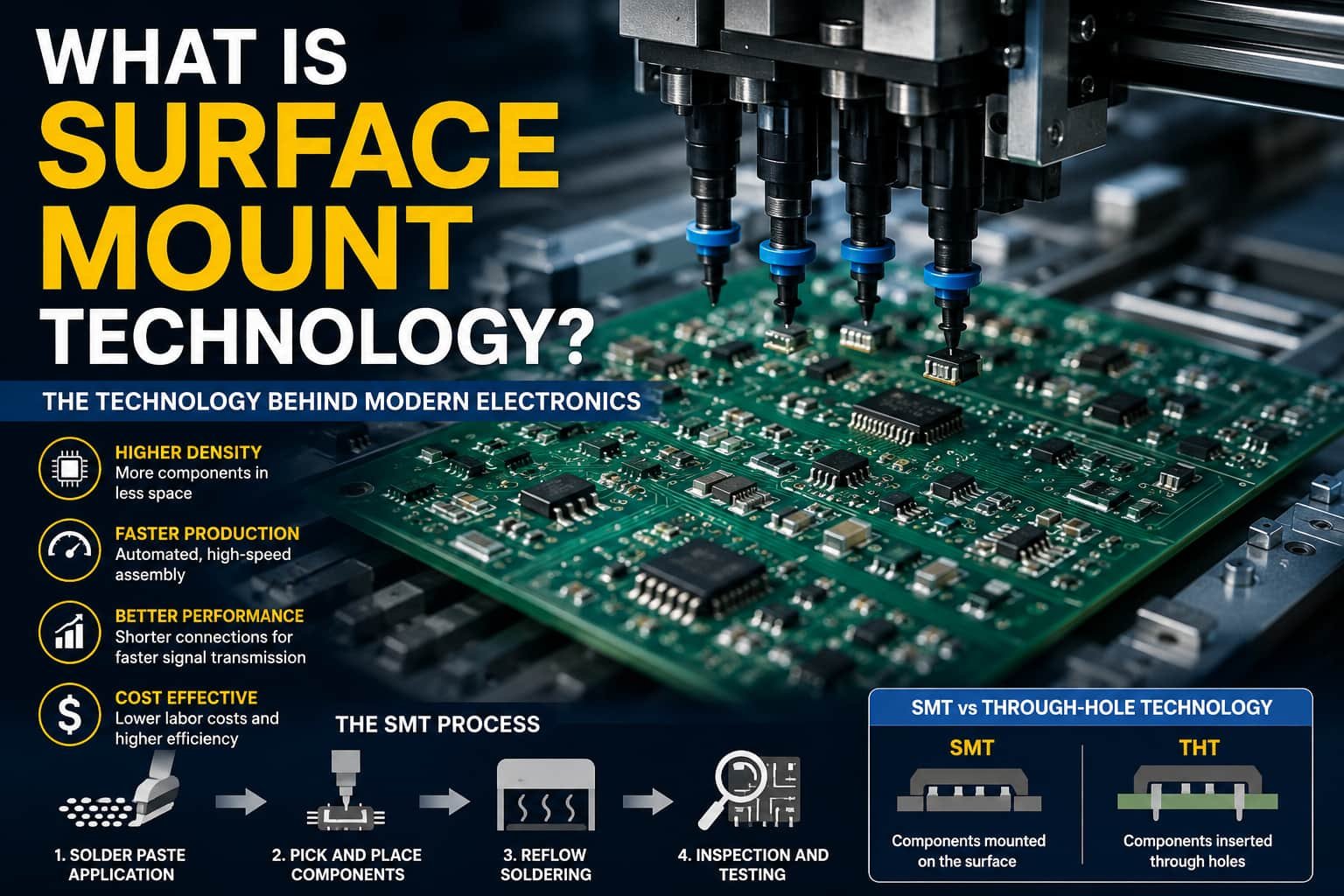
In simple terms, Surface Mount Technology (SMT) is a modern electronics manufacturing method where electronic components are mounted directly onto the surface of a Printed Circuit Board (PCB). Instead of inserting component leads through drilled holes like older Through-Hole Technology (THT), SMT allows components to sit directly on the board’s surface using automated assembly systems.
In my experience researching electronics manufacturing processes, SMT completely changed the way modern devices are designed and produced. It made electronics smaller, faster, lighter, and far more efficient to manufacture at scale.
Today, SMT electronics assembly is considered the global industry standard for producing compact, high-performance electronic devices across industries like:
- Consumer electronics
- Medical equipment
- Automotive electronics
- Aerospace systems
- Telecommunications
- Industrial automation
And honestly, without Surface Mount Technology, modern electronics as we know them probably wouldn’t exist.
Why Surface Mount Technology Became the Industry Standard
Before SMT became popular, manufacturers mainly relied on Through-Hole Technology. That process required drilling holes into circuit boards so component leads could pass through and be soldered from the opposite side.
While effective, it had several limitations:
- Larger PCB sizes
- Slower production
- More manual labor
- Lower component density
- Higher manufacturing costs
SMT solved many of these problems.
By mounting Surface Mount Devices (SMDs) directly onto the PCB surface, manufacturers could place more components closer together while also automating nearly the entire production process.
This shift allowed companies to create:
- Smaller smartphones
- Lightweight laptops
- Compact medical devices
- Advanced automotive control systems
- High-speed communication equipment
In many ways, SMT became the backbone of modern electronics manufacturing.
Key Benefits of Surface Mount Technology
One reason SMT dominates PCB manufacturing today is because the advantages go far beyond just saving space.
Let’s break down the biggest benefits.
1. Higher Component Density
One of the first things I noticed while studying SMT assembly lines is how incredibly compact modern circuit boards have become.
Because SMT eliminates the need for drilled holes, engineers can place components much closer together on both sides of the PCB.
This creates:
- Smaller circuit boards
- More powerful electronics
- Better design flexibility
- Improved signal performance
That’s why devices like smartwatches and wireless earbuds can pack so much technology into such tiny spaces.
2. Faster Production Speed
Modern SMT production lines are heavily automated.
Using advanced pick-and-place machines, manufacturers can place thousands of components per hour with incredible precision.
The automated SMT assembly process typically includes:
- Solder paste printing
- Component placement
- Reflow soldering
- Quality inspection
Compared to traditional Through-Hole Technology, SMT dramatically reduces assembly time.
In high-volume manufacturing, that speed becomes a major competitive advantage.
3. Lower Manufacturing Costs
One of the biggest reasons manufacturers switched to SMT was cost efficiency.
In my experience reviewing PCB manufacturing workflows, SMT reduces expenses in several ways:
- Less manual labor
- Faster assembly cycles
- Reduced material waste
- Smaller board sizes
- Lower shipping costs
- Better production consistency
Many Surface Mount Devices also cost less than traditional leaded components, especially in large production volumes.
4. Improved Reliability
SMT components are smaller and lighter, which reduces stress on solder joints during vibration or movement.
That’s extremely important for industries like:
- Automotive electronics
- Aerospace systems
- Industrial equipment
- Medical devices
Modern SMT soldering methods also provide highly reliable electrical connections that hold up well under demanding operating conditions.
5. Better Automation and Precision
Automation is where SMT truly shines.
Advanced electronics manufacturing facilities use:
- Automated Optical Inspection (AOI)
- X-ray inspection systems
- Precision pick-and-place robots
- AI-driven quality control
- Reflow soldering ovens
This level of automation improves:
- Accuracy
- Repeatability
- Production efficiency
- Product quality
It also minimizes human error during PCB assembly.
Read More: What Is a Technology Business?
Surface Mount Technology vs Through-Hole Technology
A lot of people confuse SMT and Through-Hole Technology, so let’s simplify the difference.
Surface Mount Technology (SMT)
- Components mounted directly on PCB surface
- Supports automated production
- Higher component density
- Smaller PCB designs
- Faster manufacturing speed
- Ideal for compact electronics
Through-Hole Technology (THT)
- Component leads inserted through drilled holes
- Often requires manual soldering
- Larger board space needed
- Strong mechanical connections
- Common in heavy-duty applications
In reality, many modern electronic products use a combination of SMT and THT depending on the application.
How the Surface Mount Technology Process Works
Now let’s walk through the actual SMT assembly process step by step.
Understanding this workflow makes it much easier to appreciate how modern electronics are built.
Step 1: Solder Paste Printing
The process begins with applying solder paste onto the PCB.
A stencil printer deposits solder paste onto specific pads where Surface Mount Devices will later be placed.
Accuracy here is critical because uneven solder paste can create defective solder joints.
Modern SMT production lines use automated inspection systems immediately after printing to detect errors early.
Step 2: Component Placement
Next comes one of the most fascinating parts of SMT manufacturing.
High-speed pick-and-place machines grab electronic components from reels or trays and position them precisely onto the PCB.
These machines are incredibly fast.
Some advanced systems can place tens of thousands of components per hour while maintaining microscopic accuracy.
In my experience watching SMT assembly videos, this stage almost looks like robotics choreography.
Step 3: Reflow Soldering
Once all components are placed, the PCB moves through a reflow soldering oven.
The heat melts the solder paste, creating permanent electrical and mechanical connections between the PCB and the components.
The temperature profile must be carefully controlled to avoid damaging sensitive electronic parts.
This stage is essential for achieving reliable SMT solder joints.
Step 4: Quality Inspection and Testing
After soldering, the board undergoes inspection and testing.
Most SMT manufacturing facilities use:
- Automatic Optical Inspection (AOI)
- X-ray inspection
- Functional testing
- Electrical verification
AOI systems check for:
- Missing components
- Incorrect placement
- Poor solder joints
- Polarity errors
Quality control is one of the most important parts of the SMT electronics assembly process because even tiny defects can cause product failure later.
Common Applications of Surface Mount Technology
SMT is everywhere in modern life.
Some of the most common SMT applications include:
Consumer Electronics
- Smartphones
- Tablets
- Smart TVs
- Gaming consoles
- Smartwatches
Medical Equipment
- Patient monitors
- Portable scanners
- Diagnostic devices
- Wearable health technology
Automotive Electronics
- Engine control units
- Sensor systems
- Navigation systems
- EV battery management systems
Aerospace and Defense
- Communication systems
- Navigation hardware
- Flight control electronics
Industrial Automation
- PLC systems
- Robotics
- Sensors
- Control panels
Without SMT, many of these technologies would be much larger, slower, and less efficient.
SMT vs SMD: What’s the Difference?
This is another common question.
Here’s the simple explanation:
- SMT = The manufacturing process
- SMD = The actual electronic component
So when someone says “Surface Mount Device,” they’re talking about the resistor, capacitor, diode, or chip mounted onto the PCB.
When they say “Surface Mount Technology,” they mean the entire assembly method.
Challenges of Surface Mount Technology
While SMT has major advantages, it’s not perfect.
Some challenges include:
- High initial equipment investment
- Complex repair and rework
- Heat-sensitive components
- Precision setup requirements
- Smaller components can be harder to inspect manually
That said, modern automation and AI-based inspection systems continue improving SMT reliability every year.
Future Trends in Surface Mount Technology
The future of SMT manufacturing looks incredibly advanced.
Some exciting trends include:
- AI-powered inspection systems
- Smart factory automation
- Advanced robotics integration
- Miniaturized electronics
- High-density PCB assembly
- Sustainable manufacturing practices
As electronic devices continue shrinking while becoming more powerful, SMT will remain central to electronics manufacturing innovation.
Final Thoughts
Surface Mount Technology completely transformed modern electronics manufacturing.
By allowing Surface Mount Devices to be mounted directly onto PCB surfaces, SMT made it possible to create smaller, faster, lighter, and more reliable electronic products.
In my experience researching manufacturing technologies, SMT stands out because it combines automation, efficiency, and precision in a way few other production methods can match.
Whether you work in electronics manufacturing, PCB assembly, product design, or simply want to understand how modern devices are built, learning the fundamentals of SMT gives you valuable insight into the technology powering today’s world.
And as automation, AI inspection, and miniaturized electronics continue evolving, Surface Mount Technology will only become more important in the future of electronics production.