
Introduction
If you’ve ever researched Mazda vehicles, you’ve probably come across the term Skyactiv Technology. The first time I encountered it, I assumed it was simply another marketing buzzword that car manufacturers use to make their vehicles sound more advanced. However, after spending time researching Mazda’s engineering approach and comparing it with traditional automotive technologies, I quickly realized Skyactiv is much more than a catchy name.
In fact, Skyactiv Technology represents a complete redesign of how vehicles are engineered. From engines and transmissions to body structures and chassis design, Mazda created Skyactiv to improve fuel economy, performance, safety, and overall driving enjoyment without relying heavily on hybrid systems or electric motors.
In this guide, I’ll explain exactly what Skyactiv Technology is, how it works, its benefits, potential drawbacks, and why it has become one of Mazda’s biggest competitive advantages.
What Is Skyactiv Technology?
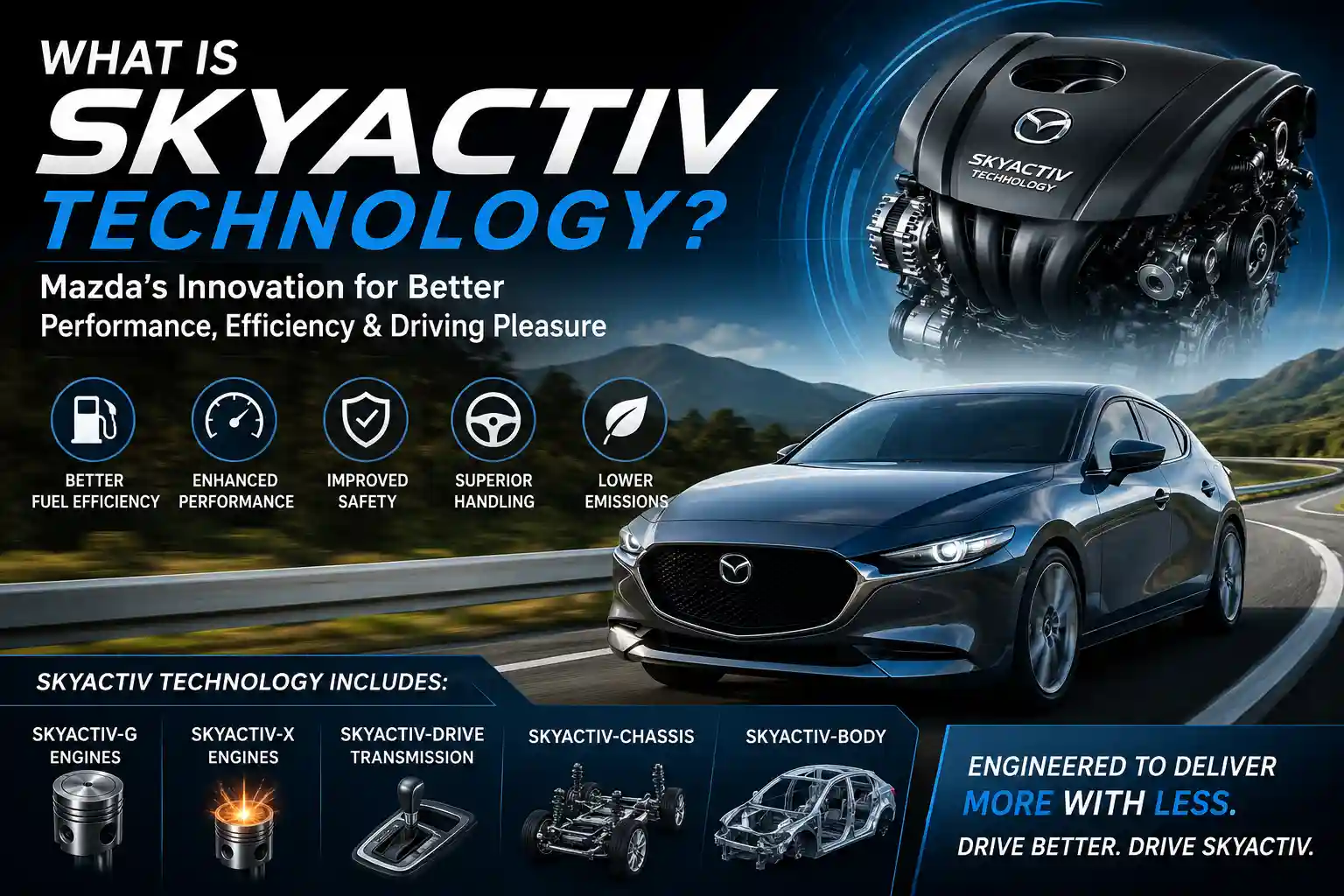
Skyactiv Technology is a suite of advanced engineering innovations developed by Mazda to improve vehicle efficiency and driving performance.
Rather than focusing on a single component, Mazda redesigned multiple parts of the vehicle, including:
- Skyactiv-G gasoline engines
- Skyactiv-D diesel engines
- Skyactiv-X engines
- Skyactiv-Drive transmissions
- Skyactiv-MT manual transmissions
- Skyactiv-Chassis
- Skyactiv-Body
The goal was simple:
Deliver better fuel economy, lower emissions, and a more engaging driving experience without sacrificing power.
Instead of following the industry trend of smaller turbocharged engines, Mazda chose to improve traditional internal combustion engines through smarter engineering.
The Story Behind Skyactiv Technology
Back in the late 2000s, automakers faced increasing pressure to improve fuel efficiency and reduce emissions.
Many brands turned toward hybrid systems and turbocharged engines.
Mazda took a different path.
Their engineers believed conventional engines still had untapped potential. Rather than making small improvements, they re-engineered almost every major vehicle system from the ground up.
The result was Skyactiv Technology, officially introduced around 2011 and continuously refined ever since.
I was skeptical at first, but after comparing Mazda vehicles with competitors in similar segments, it became clear that Skyactiv wasn’t just marketing—it genuinely changed how Mazda vehicles perform.
How Does Skyactiv Technology Work?
The key philosophy behind Skyactiv is maximizing efficiency throughout the entire vehicle.
Instead of improving one component, Mazda improved several systems simultaneously.
Let’s break them down.
Skyactiv-G Engine
The Skyactiv-G engine is Mazda’s advanced gasoline engine.
Its biggest innovation is an extremely high compression ratio compared to traditional gasoline engines.
Higher compression allows the engine to extract more energy from fuel.
Benefits of Skyactiv-G
- Better fuel economy
- Improved power delivery
- Reduced emissions
- Enhanced throttle response
In practical driving, this means you get strong acceleration while consuming less fuel.
Many Mazda models achieve impressive efficiency figures without relying heavily on turbochargers.
Skyactiv-X Engine
Skyactiv-X represents one of Mazda’s most ambitious innovations.
It combines characteristics of both gasoline and diesel engines.
What Makes It Unique?
Traditional gasoline engines use spark plugs.
Diesel engines rely on compression ignition.
Skyactiv-X uses a system called:
Spark Controlled Compression Ignition (SPCCI)
This technology allows the engine to operate more efficiently under many driving conditions.
Advantages
- Higher fuel efficiency
- Lower emissions
- Better torque
- Smooth power delivery
Many automotive experts consider Skyactiv-X one of the most innovative internal combustion engine designs in recent years.
Skyactiv-D Diesel Engine
Mazda also developed advanced diesel engines under the Skyactiv umbrella.
These engines focus on:
- Lower emissions
- Better fuel economy
- Improved reliability
- Strong low-end torque
Although diesel popularity varies by region, Skyactiv-D helped Mazda improve efficiency without compromising performance.
Skyactiv-Drive Transmission
The transmission is just as important as the engine.
Mazda designed Skyactiv-Drive to combine the best features of:
- Automatic transmissions
- Dual-clutch systems
- Continuously Variable Transmissions (CVTs)
Why It Matters
Many drivers dislike CVTs because they can feel disconnected.
Skyactiv-Drive provides:
- Smooth shifting
- Quick response
- Better efficiency
- More natural acceleration
In my experience, one reason many people enjoy driving Mazda vehicles is how responsive the transmission feels compared to some competitors.
About More Details: How to Stay Updated on New Technology: Practical Strategies That Actually Work
Skyactiv-MT Manual Transmission
For driving enthusiasts, Mazda created the Skyactiv-MT manual transmission.
Its design focuses on:
- Shorter shift throws
- Reduced friction
- Lightweight construction
- Improved driving feel
The goal was to create a manual transmission that feels precise and engaging.
Drivers often compare its shift quality to that of premium sports cars.
Skyactiv-Chassis: Better Handling and Comfort
The chassis serves as the foundation of the vehicle.
Mazda redesigned suspension geometry and steering systems to improve:
- Ride quality
- Stability
- Cornering performance
- Driver confidence
Real-World Benefits
When driving on winding roads, the vehicle feels more connected and predictable.
Mazda often receives praise for making even family-oriented vehicles feel enjoyable to drive.
Skyactiv-Body: Stronger and Lighter
Weight reduction is critical for fuel efficiency.
However, reducing weight without sacrificing safety can be challenging.
Skyactiv-Body addresses this by using:
- High-strength steel
- Strategic reinforcement
- Advanced structural design
Benefits
- Increased crash protection
- Reduced vehicle weight
- Better fuel economy
- Improved handling
Think of it like carrying a lighter backpack that’s somehow stronger than the heavier version.
Key Benefits of Skyactiv Technology
After studying Mazda’s engineering approach, several benefits consistently stand out.
1. Better Fuel Economy
One of the biggest advantages is fuel efficiency.
Skyactiv engines extract more usable energy from every drop of fuel.
This means fewer trips to the gas station.
2. Improved Driving Experience
Mazda vehicles are known for being fun to drive.
The combination of responsive engines, refined transmissions, and balanced chassis design creates a more engaging experience.
3. Lower Emissions
More efficient combustion helps reduce harmful emissions.
This supports stricter environmental standards while maintaining performance.
4. Increased Reliability
Because Mazda often avoids overly complex solutions, many Skyactiv components are designed with long-term durability in mind.
While no vehicle is maintenance-free, simplicity can often improve reliability.
5. Enhanced Safety
Skyactiv-Body contributes to stronger crash protection while maintaining a lightweight structure.
Safety and efficiency work together rather than competing against one another.
Skyactiv vs Traditional Engines
Many traditional engines improve performance by adding turbochargers and increasing complexity.
Skyactiv focuses on extracting greater efficiency from fundamental engine design.
Traditional Approach
- Smaller turbocharged engines
- Higher mechanical complexity
- Greater reliance on boost pressure
Skyactiv Approach
- High-compression engines
- Optimized combustion
- Lightweight vehicle engineering
- Balanced overall vehicle design
Neither approach is universally better, but Skyactiv offers a unique alternative that many drivers appreciate.
Which Mazda Vehicles Use Skyactiv Technology?
Today, Skyactiv Technology is found across much of Mazda’s lineup.
Popular examples include:
- Mazda3
- Mazda CX-30
- Mazda CX-5
- Mazda CX-50
- Mazda CX-90
- Mazda MX-5 Miata
Mazda continues refining and expanding Skyactiv innovations with each new generation.
Common Misconceptions About Skyactiv Technology
“It’s Just an Engine”
Not true.
Skyactiv includes the engine, transmission, body structure, and chassis.
“It’s the Same as a Hybrid”
No.
Most Skyactiv systems improve conventional engine efficiency rather than relying primarily on electric power.
“It’s Only About Fuel Economy”
Fuel efficiency is important, but Skyactiv also improves:
- Handling
- Safety
- Performance
- Comfort
- Driving enjoyment
Is Skyactiv Technology Worth It?
Based on my research, the answer is yes for many drivers.
If you want:
- Strong fuel economy
- Responsive handling
- Reliable engineering
- Modern safety features
- A more engaging driving experience
Skyactiv Technology delivers meaningful advantages.
What I found most interesting is that Mazda improved multiple vehicle systems simultaneously instead of chasing a single performance metric.
That holistic approach helps explain why many automotive reviewers consistently praise Mazda vehicles.
Quick Tips for Buyers
- Test-drive a Skyactiv-equipped Mazda before making a decision.
- Compare fuel economy ratings with competing vehicles.
- Pay attention to steering feel and transmission responsiveness.
- Consider Skyactiv-X models if available in your region.
- Review maintenance schedules to maximize long-term reliability.
Final Thoughts
Skyactiv Technology is Mazda’s comprehensive engineering philosophy designed to improve efficiency, performance, safety, and driving enjoyment.
What started as a response to fuel economy challenges evolved into one of the automotive industry’s most respected engineering platforms.
I was skeptical at first, but after learning how deeply Mazda redesigned everything from engines to chassis systems, I gained a new appreciation for the technology. Rather than relying solely on trends, Mazda chose to rethink how vehicles work at a fundamental level.
For drivers who value efficiency without sacrificing driving enjoyment, Skyactiv Technology remains one of the most compelling innovations in modern automotive engineering.
Have you driven a Skyactiv-equipped Mazda? Share your experience or thoughts in the comments—I’d love to hear what stood out to you most.
Frequently Asked Questions
1. What does Skyactiv mean?
Skyactiv is Mazda’s engineering platform that includes advanced engines, transmissions, chassis systems, and vehicle structures designed to improve fuel economy, performance, and safety.
2. Is Skyactiv Technology reliable?
Generally, Skyactiv systems have earned a positive reputation for reliability thanks to Mazda’s focus on efficient and relatively straightforward engineering solutions.
3. Is Skyactiv better than a hybrid?
It depends on your priorities. Hybrids typically achieve better fuel economy, while Skyactiv focuses on maximizing efficiency and driving enjoyment from conventional engine technology.