
A few months ago, I was reading about how some manufacturers can build products faster than their competitors without sacrificing quality. At first, I assumed they simply had bigger factories or more expensive equipment. But after digging deeper, I discovered something much more interesting—many of them were using Demand Flow Technology (DFT).
I was skeptical at first because “Demand Flow Technology” sounded like another complicated business buzzword. However, once I understood the concept, it became surprisingly practical. Instead of producing huge amounts of inventory and hoping customers buy it later, DFT focuses on producing products based on actual customer demand. That simple shift can dramatically improve efficiency, reduce waste, and lower operating costs.
In today’s competitive manufacturing world, businesses can’t afford to produce too much or too little. Customers expect faster delivery, customized products, and consistent quality. That’s where Demand Flow Technology comes in.
In this guide, I’ll explain what Demand Flow Technology is, how it works, its key principles, advantages, challenges, and why many manufacturers continue to adopt it as part of their lean production strategies.
What Is Demand Flow Technology?
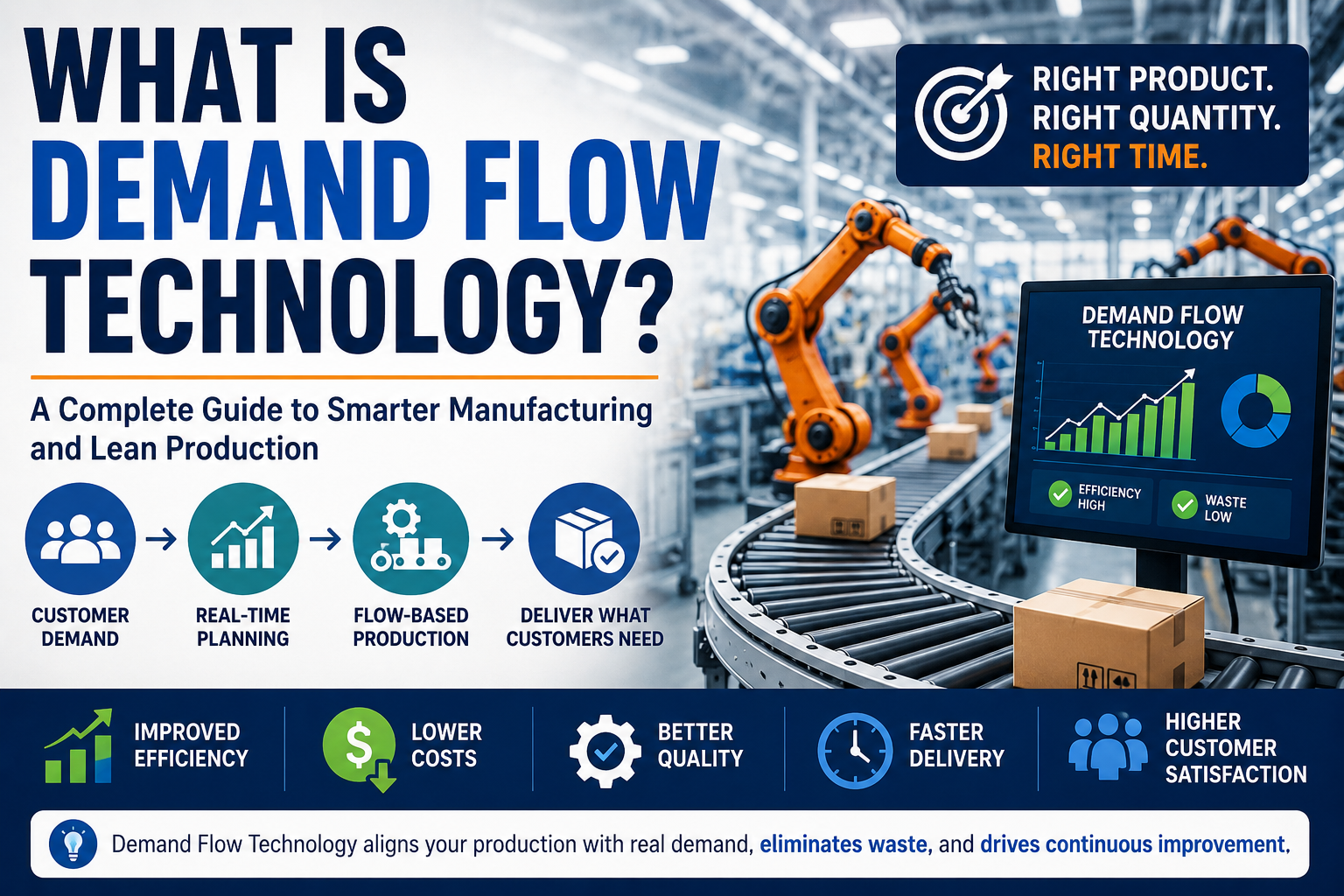
Demand Flow Technology (DFT) is a manufacturing methodology that organizes production around actual customer demand instead of forecasts. Rather than producing products in large batches, companies manufacture goods only when they’re needed or in quantities that closely match customer orders.
The concept combines ideas from:
- Lean Manufacturing
- Just-in-Time (JIT) production
- Continuous Improvement
- Flow Manufacturing
- Demand-Driven Planning
Its primary goal is simple:
Produce the right product, in the right quantity, at the right time.
Instead of warehouses full of unsold inventory, manufacturers create smooth production flows that respond quickly to changing customer needs.
Read More: What Is Computer Technology?
How Demand Flow Technology Works
When I first learned about DFT, I imagined it as a traffic management system.
Think about a busy highway.
If too many cars enter at once, traffic jams happen.
If too few cars enter, the road is underused.
Manufacturing works the same way.
Demand Flow Technology balances production so materials, workers, and machines move smoothly without unnecessary delays.
The process generally follows these steps:
Analyze customer demand
Manufacturers study real purchasing patterns rather than relying entirely on long-term forecasts.
Design production flow
Workstations are arranged to minimize delays and unnecessary movement.
Balance workloads
Every production step is adjusted so each station completes work at roughly the same pace.
Produce based on demand
Production begins only when demand exists or inventory reaches predefined levels.
Monitor continuously
Performance is constantly measured to improve quality and efficiency.
Key Principles of Demand Flow Technology
Understanding DFT becomes easier when you break it into its core principles.
Customer-Driven Production
Everything begins with customer demand.
Instead of pushing products into the market, companies respond to actual customer needs.
Continuous Flow
Products move smoothly through production with minimal waiting.
The goal is eliminating bottlenecks and unnecessary interruptions.
Waste Reduction
One of DFT’s biggest strengths is reducing waste.
This includes:
- Excess inventory
- Waiting time
- Unnecessary transportation
- Overproduction
- Rework
- Defects
Flexible Manufacturing
Modern customers often want personalized products.
Demand Flow Technology allows manufacturers to adjust production much faster than traditional systems.
Continuous Improvement
DFT isn’t a one-time project.
Companies continually evaluate performance and make improvements over time.
Benefits of Demand Flow Technology
One reason manufacturers adopt DFT is its impressive list of advantages.
Faster Production
By reducing unnecessary waiting between production stages, products reach customers more quickly.
Lower Inventory Costs
Instead of storing large quantities of products, manufacturers produce closer to actual demand.
This reduces:
- Warehouse costs
- Inventory carrying costs
- Obsolete stock
Better Product Quality
Smaller production batches make quality problems easier to identify.
Issues can often be corrected before thousands of defective products are produced.
Increased Flexibility
Businesses can respond more quickly when customer demand changes.
This became especially important during recent global supply chain disruptions.
Improved Customer Satisfaction
Customers receive products faster while businesses reduce delivery delays.
Demand Flow Technology vs Traditional Manufacturing
One question I often hear is whether DFT simply replaces traditional manufacturing.
Not exactly.
Traditional production often focuses on maximizing machine utilization by producing large batches.
Demand Flow Technology focuses on customer demand and production flow instead.
Traditional manufacturing may produce months of inventory in advance.
DFT aims to produce what customers actually need, reducing waste and increasing responsiveness.
Neither approach is universally better, but DFT often performs exceptionally well in industries where demand changes frequently.
Real-World Examples of Demand Flow Technology
Many well-known manufacturers use principles similar to Demand Flow Technology.
Automotive Industry
Vehicle manufacturers often organize production around customer orders while minimizing inventory throughout the assembly process.
Electronics Manufacturing
Companies producing smartphones, laptops, and consumer electronics frequently adjust production according to market demand to avoid excess inventory.
Medical Equipment
Hospitals and healthcare suppliers increasingly rely on demand-driven manufacturing to ensure critical products remain available while minimizing unnecessary stock.
Consumer Goods
Food manufacturers, household product companies, and packaging businesses also use demand-based production methods to improve efficiency.
Common Challenges of Demand Flow Technology
Like every manufacturing strategy, DFT isn’t perfect.
Accurate Demand Data
If customer demand information is inaccurate, production planning becomes difficult.
Solution
Use modern forecasting software and real-time sales data.
Supply Chain Coordination
Suppliers must deliver materials on time.
Late deliveries can interrupt production.
Solution
Develop strong supplier relationships and maintain clear communication.
Employee Training
Workers often need training before transitioning from traditional production methods.
Solution
Invest in continuous education and cross-functional teamwork.
Technology Investment
Some companies need upgraded software or production systems.
Solution
Implement DFT gradually rather than changing everything at once.
Tools That Support Demand Flow Technology
Several software platforms help manufacturers implement demand-driven production.
Examples include:
- SAP ERP
- Oracle NetSuite
- Microsoft Dynamics 365
- Siemens Digital Industries Software
- Plex Manufacturing Cloud
These tools provide:
- Production scheduling
- Inventory management
- Demand forecasting
- Supply chain visibility
- Performance reporting
While software alone doesn’t create Demand Flow Technology, it supports faster and more accurate decision-making.
My Personal Perspective on Demand Flow Technology
While researching DFT, I initially expected it to be another complicated manufacturing framework that only large corporations could implement.
Instead, I realized the underlying idea is surprisingly simple.
It’s really about listening to customers before making products.
That principle applies beyond manufacturing.
Even small businesses benefit when they understand customer demand instead of guessing what people might want.
The more I explored DFT, the more I appreciated that it isn’t just about efficiency—it’s about reducing waste while creating more value for customers.
Best Practices for Implementing Demand Flow Technology
If a business is considering DFT, these steps can improve success.
Understand customer demand
Collect reliable sales data.
Simplify workflows
Remove unnecessary production steps.
Train employees
Everyone should understand demand-driven production.
Measure performance
Track:
- Lead time
- Inventory turnover
- Production efficiency
- Customer satisfaction
Continuously improve
Small improvements made consistently often deliver the biggest long-term results.
Quick Tips
If you’re new to Demand Flow Technology, remember these essentials:
- Focus on actual customer demand rather than forecasts alone.
- Keep inventory lean but sufficient.
- Improve production flow continuously.
- Invest in employee training.
- Use technology to monitor production in real time.
- Build strong supplier partnerships.
Frequently Asked Questions
What is Demand Flow Technology in simple terms?
Demand Flow Technology is a manufacturing approach that produces goods based on actual customer demand instead of producing large amounts in advance.
Is Demand Flow Technology the same as Lean Manufacturing?
Not exactly. Demand Flow Technology builds on many Lean Manufacturing principles, but it places a stronger emphasis on aligning production directly with customer demand and maintaining continuous flow.
Which industries use Demand Flow Technology?
DFT is commonly used in automotive manufacturing, electronics, medical devices, consumer goods, aerospace, and other industries where efficiency and responsiveness are essential.
Conclusion
Demand Flow Technology has transformed how many manufacturers think about production. Instead of filling warehouses with inventory based on uncertain forecasts, DFT encourages businesses to produce what customers actually need, when they need it.
In my experience researching this topic, the biggest takeaway wasn’t the technology itself—it was the mindset behind it. Companies that focus on customer demand, eliminate unnecessary waste, and continuously improve their processes are often better equipped to compete in today’s fast-changing marketplace.
Although implementing Demand Flow Technology requires planning, training, and strong supply chain coordination, the potential rewards—faster production, lower costs, improved quality, and happier customers—make it a valuable strategy for many organizations.
Whether you’re a manufacturing professional, business student, or simply curious about modern production systems, understanding Demand Flow Technology provides valuable insight into how today’s most efficient companies deliver products faster while minimizing waste.