
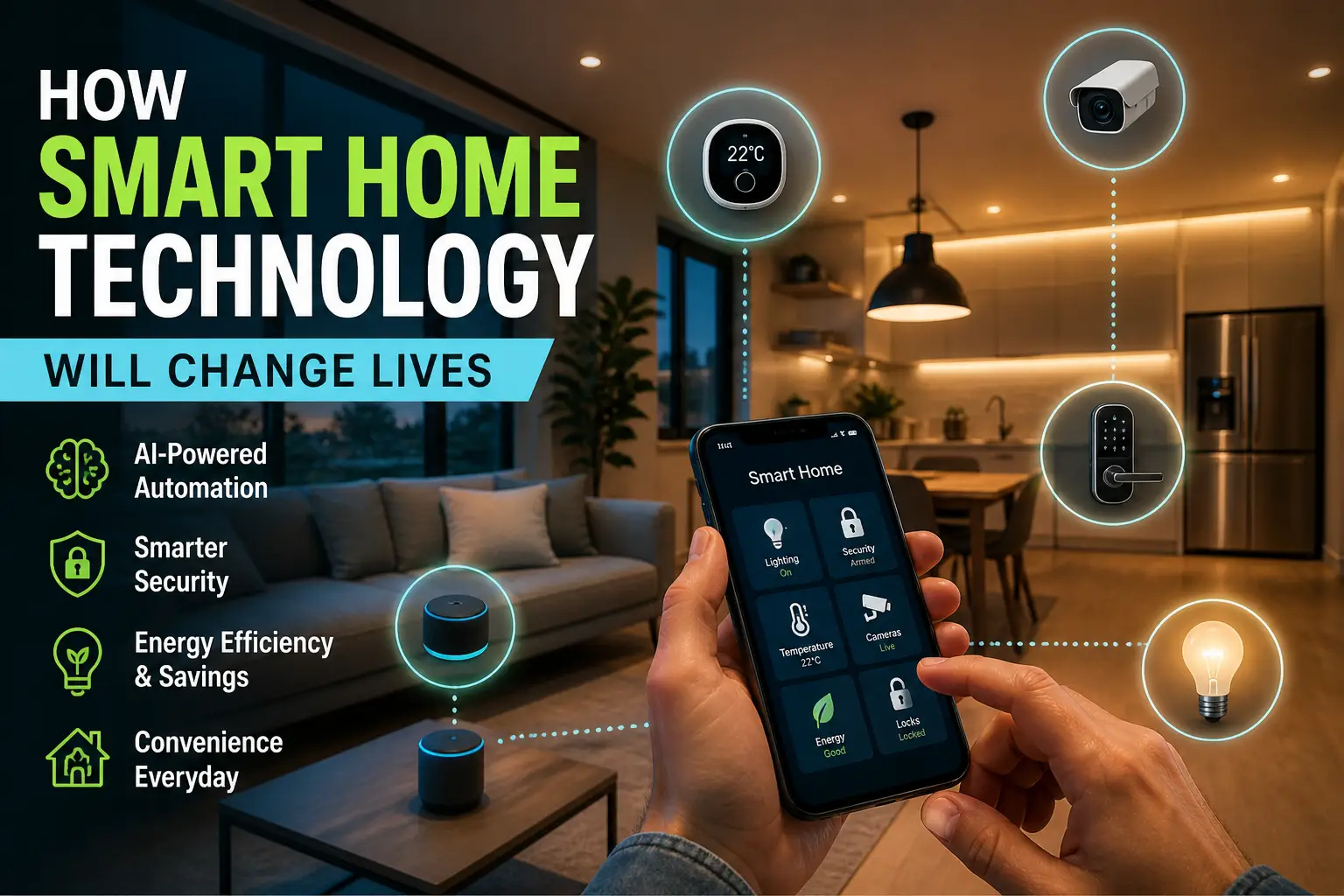
Introduction:
A few months ago, I had one of those small but eye-opening moments.
I walked into my house after a long day, and before I even touched anything, the lights adjusted, the room felt perfectly cool, and soft music started playing. I didn’t set anything manuall, it just knew.
That’s when it hit me: smart home technology isn’t about gadgets anymore, it’s about lifestyle transformation.
Today, homes are becoming adaptive, AI-driven environments that learn your habits, reduce effort, and even cut down your energy bills. In this guide, I’ll break down exactly how smart home technology will change lives, based on real use cases, practical insights, and what I’ve personally experienced while testing different setups.
What Is Smart Home Technology?
At its core, Smart Home Technology refers to a system where devices inside your home are connected and controlled through the internet.
These devices communicate using the Internet of Things, allowing them to automate tasks like:
- Adjusting temperature
- Turning lights on/off
- Managing security systems
- Monitoring energy usage
Instead of manually controlling everything, your home becomes responsive and intelligent.
How Smart Homes Actually Work
Most smart homes rely on a central ecosystem like:
- Amazon Alexa
- Google Home
- Apple HomeKit
These platforms connect devices using standards like Zigbee or Matter.
In simple terms:
Your devices “talk” to each other and follow routines you set, or even better, routines they learn automatically.
Key Ways Smart Home Technology Will Change Lives
1. Predictive Personalization (Your Home Learns You)
This is where things get interesting.
Modern smart homes use AI to learn your daily routine:
- Wake-up time
- Sleep patterns
- Temperature preferences
For example:
- Lights turn on gradually in the morning
- Coffee starts brewing automatically
- Bathroom gets pre-warmed
I tested this with a smart thermostat, and within a week, it adjusted better than I ever could manually.
It feels less like controlling a home and more like living in one that understands you.
2. Advanced Security Without the Stress
Security is no longer just locks and cameras.
Smart homes now offer:
- Biometric access (fingerprint, facial recognition)
- Real-time alerts
- Remote door control
Devices like video doorbells let you see who’s outside—even when you’re not home.
I’ve personally checked deliveries while traveling, and it genuinely adds peace of mind.
3. Energy Efficiency That Actually Saves Money
One of the biggest benefits is smarter energy usage.
With Smart Energy Management, your home can:
- Track electricity usage in real time
- Automatically reduce waste
- Optimize appliances
For example:
- Thermostats adjust when you leave
- Appliances run during cheaper hours (via Time of Use Pricing)
Some systems, like Nest thermostats, have shown up to 15–20% energy savings.
In my case, I noticed a clear drop in electricity usage within the first month.
4. Convenience Through Automation
This is where smart homes shine the most.
Imagine:
- Lights turning off automatically at night
- Curtains adjusting with sunrise
- Robot vacuums cleaning on schedule
It removes dozens of small daily tasks.
It may sound minor, but over time, it saves hours every week.
5. Health and Safety Monitoring
Modern smart homes go beyond comfort.
They can:
- Detect smoke, gas leaks, or unusual activity
- Monitor indoor air quality
- Alert you instantly in emergencies
Some systems even act like an “external brain,” constantly watching over your environment.
Read More About: How Technology Has Changed People’s Activity Levels
How Smart Homes Are Changing Energy Use Forever
Real-Time Energy Monitoring
Instead of guessing your electricity usage, you can now see:
- Which appliance consumes the most power
- When usage spikes
- Where you can save
This level of control was impossible a few years ago.
Automated Energy Decisions
Your home can now act on energy data:
- Close blinds during peak heat
- Reduce cooling when no one is home
- Shift heavy usage to off-peak hours
This happens in the background—no manual effort needed.
Moving Toward Energy Independence
With the addition of:
- Solar panels (Solar Energy)
- Battery storage
- Backup Power Systems
Homes are becoming self-sufficient energy systems.
How to Start a Smart Home (Step-by-Step Guide)
1. Start Small (Don’t Overcomplicate It)
Begin with:
- Smart plugs
- Smart bulbs
- Voice assistant
These are affordable and easy to set up.
2. Choose One Ecosystem
Stick with one platform:
- Alexa
- Apple
Mixing systems often creates compatibility issues.
3. Upgrade Your Wi-Fi
A weak connection = a broken smart home.
I upgraded to a mesh system, and it solved:
- Device lag
- Connectivity drops
4. Automate Daily Routines
Create simple “scenes” like:
- Good Morning
- Good Night
- Away Mode
This is where everything starts working together.
5. Focus on Security First
Always:
- Enable 2FA
- Use strong passwords
- Update firmware regularly
Read More About: What Technology Innovations Happened in California? A Deep Dive Into the World’s Tech Powerhouse
Common Problems (And How to Fix Them)
Problem: Devices not connecting
Solution: Use a stronger Wi-Fi or mesh network
Problem: Too many apps
Solution: Stick to one ecosystem
Problem: High setup cost
Solution: Start small and scale gradually
Real-Life Example: A Day in a Smart Home
Here’s how my routine looks now:
Morning
- Lights fade in
- Coffee machine starts
- News briefing via voice assistant
Afternoon
- AC reduces when I leave
- Security cameras stay active
Night
- Doors lock automatically
- Lights turn off
- Temperature adjusts for sleep
Everything runs without constant input.
The Future of Smart Homes (What’s Coming Next)
We’re moving toward:
- Fully AI-driven homes
- Touchless controls
- Deeper personalization
- Integrated energy ecosystems
Soon, homes won’t just respond—they’ll predict and act before you even think.
FAQs
1. What are smart home devices?
Smart home devices are internet-connected tools like lights, thermostats, and cameras that automate tasks and improve convenience, security, and energy efficiency.
2. How much does a smart home cost?
You can start with as little as $50–$200 for basic devices, while advanced setups can cost thousands depending on automation and energy systems.
3. Is smart home technology safe?
Yes, if you use proper security measures like strong passwords, two-factor authentication, and regular updates.
Quick Tips (If You’re Starting Today)
- Start small, then expand
- Focus on automation, not just devices
- Choose compatibility over features
- Prioritize security
Conclusion: A Smarter Way to Live
Smart home technology is no longer a luxury, it’s becoming a practical necessity.
From saving time and reducing energy bills to improving safety and comfort, it’s reshaping how we live every day.
In my experience, once you start, there’s no going back.
Because the real benefit isn’t just convenience, it’s having a home that works for you, not the other way around.