
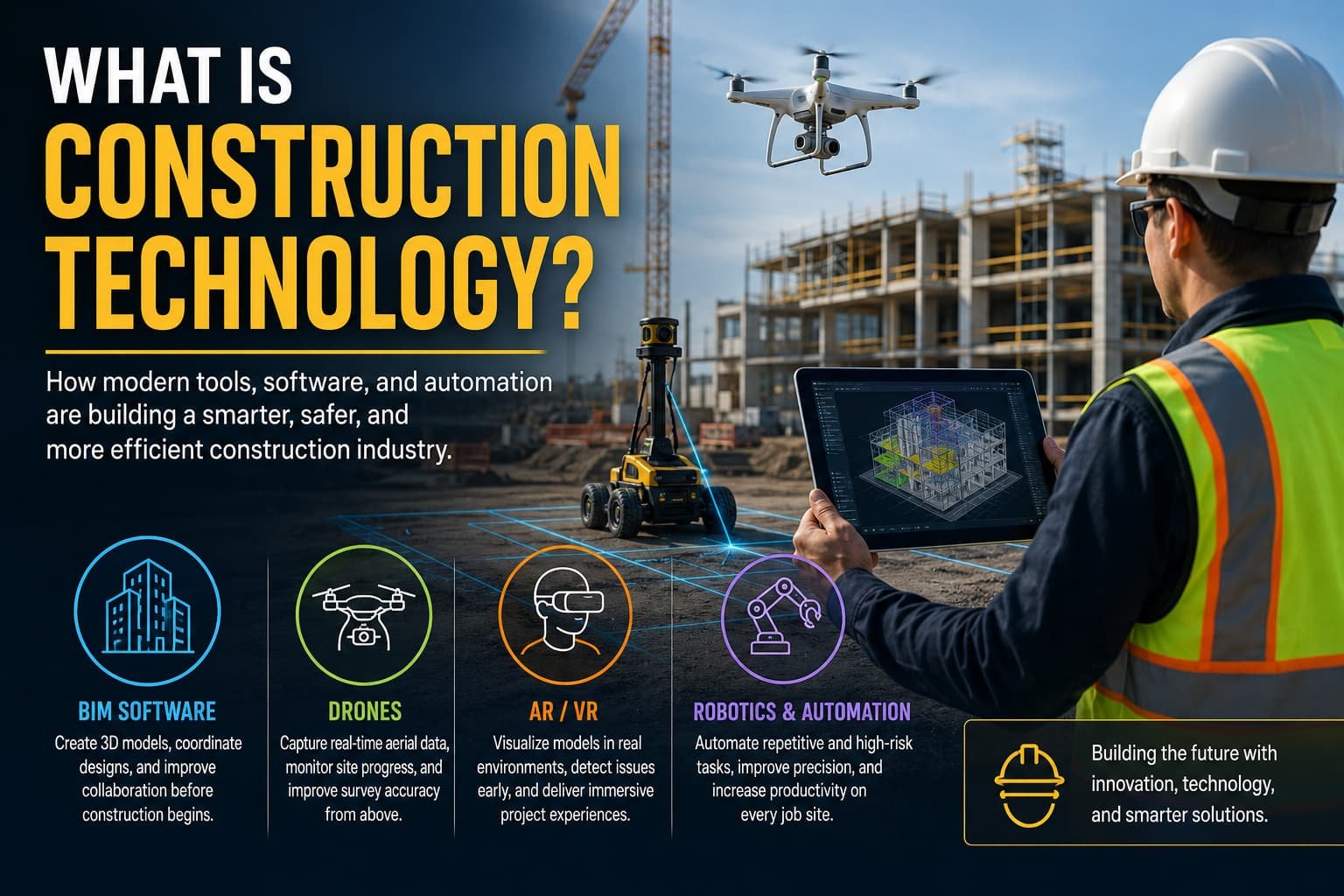
In my experience working around modern construction workflows and observing how sites operate today, one thing is clear: construction is no longer just about bricks, cement, and manual labor. It has become a highly digital, data-driven, and automated industry.
Over the past few years, I’ve seen construction teams struggle with familiar problems:
- Skilled labor shortages slowing down projects
- Rising material costs due to inflation
- Safety risks on complex job sites
- Miscommunication between design and field teams
- Constant delays and rework
These challenges are exactly why construction technology has become essential, not optional.
Before diving deeper, here’s a clear, updated understanding of the concept.
AI Overview (Updated Understanding of Construction Technology)
Construction technology (often called ConTech) refers to the collection of modern tools, machinery, software, and digital systems used to improve how construction projects are planned, executed, and managed.
In simple terms, it helps teams build faster, safer, and more efficiently.
It generally falls into three major categories:
1. Digital Project Software
- Building Information Modeling (BIM)
- Cloud-based project management systems that track schedules, budgets, materials, and workforce activities
2. Robotics & Construction Hardware
- Construction Drones for mapping and inspections
- 3D Construction Printing
- Robotic Layout Systems used for precision work
3. Site Intelligence & Safety Systems
- Wearable sensors that track worker health, movement, and hazards
- Augmented Reality (AR) Construction Tools
- Virtual reality tools that allow immersive building simulations before construction begins
Why it matters
Construction technology reduces manual errors, improves worker safety, lowers waste, and increases speed. It allows teams to work with better coordination and smarter decision-making.
Now, let’s break it down in a more practical way.
What is Construction Technology? (Simple Explanation)
From my perspective, construction technology is best understood as the “smart layer” added to traditional construction work.”
Instead of relying only on manual effort, teams now use:
- Software for planning and coordination
- Machines for automation and precision
- Digital systems for communication and tracking
- Smart devices for safety and monitoring
In short, construction technology helps transform a complex building process into a more controlled, predictable, and efficient system.
It doesn’t replace human workers, it enhances their capability.
Read More: What Is Hybrid Technology?
The Real Problems Construction Technology Solves
When I look at construction projects without modern tools, I consistently notice the same issues:
1. Delays in Project Timelines
Small miscalculations or communication gaps often lead to weeks of delay.
2. Safety Risks
Construction sites are high-risk environments where accidents can easily happen.
3. Budget Overruns
Poor planning or rework increases material and labor costs.
4. Coordination Issues
Design teams, engineers, and field workers often struggle to stay aligned.
5. Material Waste
Incorrect measurements or manual errors lead to unnecessary waste.
Construction technology directly targets all these problems.
Key Categories of Construction Technology
Let’s explore the core areas that define modern construction systems.
1. Digital Construction Software
This is the backbone of modern construction workflows.
Building Information Modeling (BIM)
Building Information Modeling (BIM) allows teams to create detailed digital representations of buildings before they are built.
In my experience, BIM reduces misunderstandings between architects and contractors because everyone works from the same visual model.
Project Management Tools
Cloud-based systems track:
- Budget usage
- Task progress
- Workforce allocation
- Material delivery
These tools improve transparency and accountability across teams.
2. Robotics, Drones & Automation
This is where construction starts feeling truly futuristic.
Construction Drones
Construction Drones are used for:
- Site mapping
- Progress tracking
- Hard-to-reach inspections
I’ve seen drones reduce inspection time from hours to minutes.
3D Construction Printing
3D Construction Printing is revolutionizing how structures are created.
It allows builders to produce:
- Wall structures
- Concrete components
- Custom architectural designs
This reduces both cost and construction time.
Robotic Layout Systems
Robotic Layout Systems help print accurate layouts directly onto job sites.
One example I’ve studied closely is automated layout systems like those used in advanced field printing solutions, which significantly reduce rework and errors.
3. Safety & Smart Wearable Systems
Safety is one of the biggest improvements in construction technology.
Wearables and Sensors
These include:
- Smart helmets
- GPS tracking boots
- Temperature and hazard sensors
- Heart rate monitors
They help supervisors respond quickly to risk situations.
AR and VR in Construction
Augmented Reality (AR) Construction Tools and VR systems are used for:
- Virtual building walkthroughs
- Design validation before construction
- On-site guidance using overlays
In my experience, AR reduces costly mistakes during installation phases.
Benefits of Construction Technology
From everything I’ve observed, the impact is very clear.
1. Improved Safety
Automation reduces human exposure to dangerous tasks.
2. Faster Project Completion
Tasks that used to take weeks can now be done in days.
3. Better Accuracy
Digital models eliminate guesswork.
4. Lower Costs
Less waste, fewer errors, and optimized resource use.
5. Better Collaboration
Teams work in sync using cloud-based systems.
How Construction Technology Changes Real Projects
Let me give a simple example from a real-world workflow:
Before construction tech:
- Engineers design on paper
- Field teams interpret manually
- Errors happen during execution
- Rework becomes common
After construction tech:
- BIM creates a shared digital model
- Drones scan and verify site conditions
- AR tools guide installation
- Robotics handle precision tasks
The difference is massive in terms of speed and quality.
Choosing the Right Construction Technology
If I were advising a construction company, I would focus on these key decision factors:
1. Project Needs
Understand whether you need:
- Design tools
- Safety systems
- Automation tools
2. Ease of Use
Technology must be practical for field teams.
3. Integration
It should work with existing systems like BIM or CAD tools.
4. Budget Planning
Not every solution is cost-effective for all project sizes.
5. Mobility
Field workers need mobile access for real-time updates.
The Future of Construction Technology
Construction is heading toward full digital transformation.
We are already seeing:
- AI-assisted project planning
- Smart job sites with sensors
- Fully automated construction processes
- Digital twins of entire buildings
- Robotics replacing repetitive manual labor
The industry is shifting from reactive problem-solving to predictive and automated decision-making.
Conclusion:
In my experience, construction technology is no longer a “future concept” it is already shaping how modern buildings are designed and delivered.
What stands out most is this:
Construction technology does not remove the human role, it enhances it.
Workers become more skilled, projects become more predictable, and outcomes become significantly more efficient.