
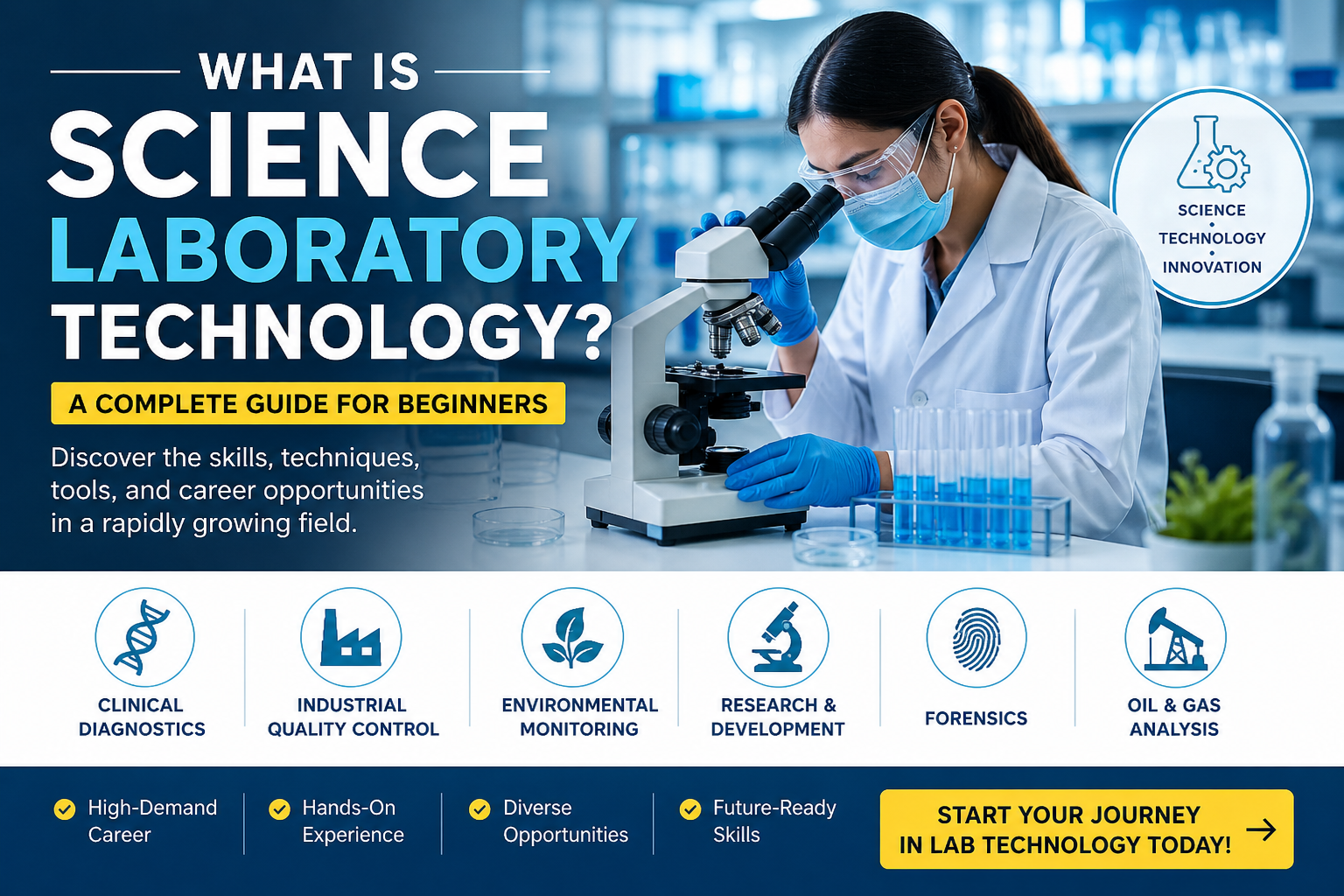
Introduction: The Moment I Realized How Powerful Lab Technology Really Is
A few months ago, I visited a small diagnostic lab with a friend who needed routine blood tests. What surprised me wasn’t the test itself, it was the speed, precision, and automation behind it. Within minutes, machines processed samples, software analyzed data, and results were ready faster than I expected.
That experience made me curious:
What exactly is science laboratory technology, and why is it so important today?
If you’ve ever wondered the same, you’re in the right place.
In this guide, I’ll walk you through everything, from basic concepts to advanced technologies, skills, and career opportunities, in a simple, human way.
What Is Science Laboratory Technology?
Science Laboratory Technology (SLT) is an applied science field that focuses on the tools, techniques, and procedures used to perform scientific experiments, analyze samples, and ensure accurate results.
In simple words:
It’s the practical side of science, where theories are tested in real labs.
It combines:
- Scientific research
- Laboratory equipment handling
- Data analysis
- Quality control
Professionals in this field, called laboratory technicians or technologists, work behind the scenes in industries like healthcare, pharmaceuticals, and environmental science.
Where Is Science Laboratory Technology Used?
One of the most interesting things I discovered is how widely SLT is used. It’s not just labs, it’s everywhere.
Clinical Diagnostics
- Testing blood, urine, and tissues
- Detecting diseases early
- Supporting doctors with accurate reports
This is where lab technicians play a life-saving role
Industrial Quality Control
- Testing food, beverages, and manufactured products
- Ensuring safety standards
For example, companies like Pfizer rely heavily on lab testing for drug safety.
Environmental Monitoring
- Analyzing water, air, and soil
- Detecting pollution and contaminants
Research & Development
- Supporting innovation in biotech and pharmaceuticals
- Assisting scientists in experiments
Organizations like National Institutes of Health depend on lab professionals daily.
Forensics & Oil/Gas Analysis
- Crime investigation (DNA, fingerprints)
- Testing oil and gas samples for efficiency
Core Techniques Used in Laboratory Technology
When I started exploring SLT, I realized it’s not just about “testing”—it’s about precision techniques across multiple sciences.
Biological Techniques
- DNA extraction
- Microscopy
- Bacterial culture
- Staining methods
Tools from Leica Microsystems are widely used here.
Chemical Techniques
- Titration
- Chromatography
- Spectrophotometry
- Reagent preparation
Physical Techniques
- Instrument calibration
- Measurement systems
- Data analysis
Read More Deatails: How to Get Ancient Technology Points in Palworld (Complete Guide)
Modern Advancements in Science Laboratory Technology
This is where things get really exciting.
Over the past few years, lab technology has evolved dramatically.
Automation & Robotics
Automation has completely changed lab workflows.
- Robots handle repetitive tasks
- Faster sample processing
- Reduced human error
Companies like Tecan Group develop advanced robotic systems used globally.
From my perspective:
Automation doesn’t replace humans, it frees them to focus on critical thinking and analysis.
Digital Tools & Data Analysis
Modern labs rely heavily on data.
- Laboratory Information Management Systems (LIMS)
- Cloud-based data storage
- AI-powered analysis
Platforms from LabWare help labs manage massive datasets efficiently.
Genomic & Molecular Technologies
This is one of the fastest-growing areas.
- PCR (DNA amplification)
- Next-Generation Sequencing (NGS)
- Gene editing (CRISPR)
Companies like Illumina are leading innovation in genome sequencing.
Advanced Imaging Technologies
- Confocal microscopy
- Electron microscopy
- MRI
These tools allow scientists to see inside cells and tissues in incredible detail.
Read More Deatails: How Smart Home Technology Will Change Lives
Skills Required in Science Laboratory Technology
From what I’ve observed, technical knowledge alone isn’t enough—you need a mix of skills.
Technical Proficiency
- Operating lab equipment
- Understanding protocols
- Using digital systems
Analytical Thinking
- Interpreting results
- Solving unexpected problems
Attention to Detail
Even small mistakes can ruin results.
I’ve seen how a tiny labeling error can lead to completely wrong conclusions.
Communication & Teamwork
- Writing reports
- Collaborating with scientists
Adaptability
Technology keeps changing, learning never stops.
Career Opportunities in Science Laboratory Technology
One of the biggest reasons people search this topic is career potential, and honestly, it’s strong.
Healthcare Laboratories
- Clinical lab technician
- Diagnostic specialist
Pharmaceutical & Biotech Industry
- Drug testing
- Research assistant
- Quality control analyst
Environmental Labs
- Pollution analysis
- Sustainability research
Industrial & Manufacturing Labs
- Product testing
- Materials research
Academic & Research Institutions
- Lab assistant
- Research technician
Is It a Good Career?
From everything I’ve studied:
✔ Growing demand
✔ Diverse opportunities
✔ Stable career path Especially with the rise of AI, biotech, and healthcare innovation
How to Start a Career in Laboratory Technology
If you’re thinking about entering this field, here’s a simple path:
Step 1: Get Relevant Education
- Diploma or degree in lab technology or science
Step 2: Learn Practical Skills
- Hands-on lab training
- Internships
Step 3: Get Certified
- Professional certifications improve job chances
Step 4: Build Experience
- Entry-level lab roles
- Research assistant jobs
Step 5: Keep Learning
- Stay updated with new technologies
Common Challenges (And How to Handle Them)
Challenge: Complex Equipment
Solution: Practice + training
Challenge: Data Overload
Solution: Learn digital tools like LIMS
Challenge: Rapid Technology Changes
Solution: Continuous learning
Quick Tips (From My Research)
✔ Focus on practical skills, not just theory
✔ Learn basic data analysis tools
✔ Stay updated with lab innovations
✔ Network with professionals
✔ Don’t ignore safety protocols
FAQs
1. What does a laboratory technician do?
A laboratory technician performs tests, analyzes samples, operates equipment, and records results to support scientific research and healthcare.
2. Is science laboratory technology a good career?
Yes, it offers stable job opportunities, growing demand, and roles in multiple industries like healthcare, biotech, and research.
3. What qualifications are required for lab technology?
Typically, a diploma or degree in science laboratory technology, along with practical training and certifications.
Conclusion: Why Science Laboratory Technology Matters More Than Ever
After exploring this field deeply, one thing is clear:
Science laboratory technology is the backbone of modern science and healthcare.
From diagnosing diseases to developing life-saving drugs, it plays a critical role in shaping our world.
And the best part?
It’s a field full of opportunity, innovation, and impact.
Final Takeaways
- SLT is the practical application of science
- Used across healthcare, industry, and research
- Driven by automation, AI, and genomics
- Requires both technical and analytical skills
- Offers strong and growing career opportunities