
Introduction: Why Decluttering Feels So Hard (And Why It’s Worth It)
I’ll be honest, my first real attempt at decluttering was a disaster.
I pulled everything out of my closet, sat on the floor surrounded by piles of clothes, and within 20 minutes… I was overwhelmed, frustrated, and somehow more stressed than before. Sound familiar?
That’s the thing about clutter—it’s not just physical. It’s emotional. It’s mental. And if you don’t approach it the right way, it can feel like an impossible task.
But here’s what I’ve learned after years of testing methods, researching experts like Marie Kondo, and trying everything from the “hanger trick” to the “90/90 rule”:
👉 Decluttering isn’t about throwing things away.
👉 It’s about editing your life.
And once you get that mindset shift, everything changes.
Overview: The Fastest Way to Start Decluttering
Before we dive deep, here’s a quick, beginner-friendly framework you can start today:
- Start small—one drawer, one surface, or a 15-minute session
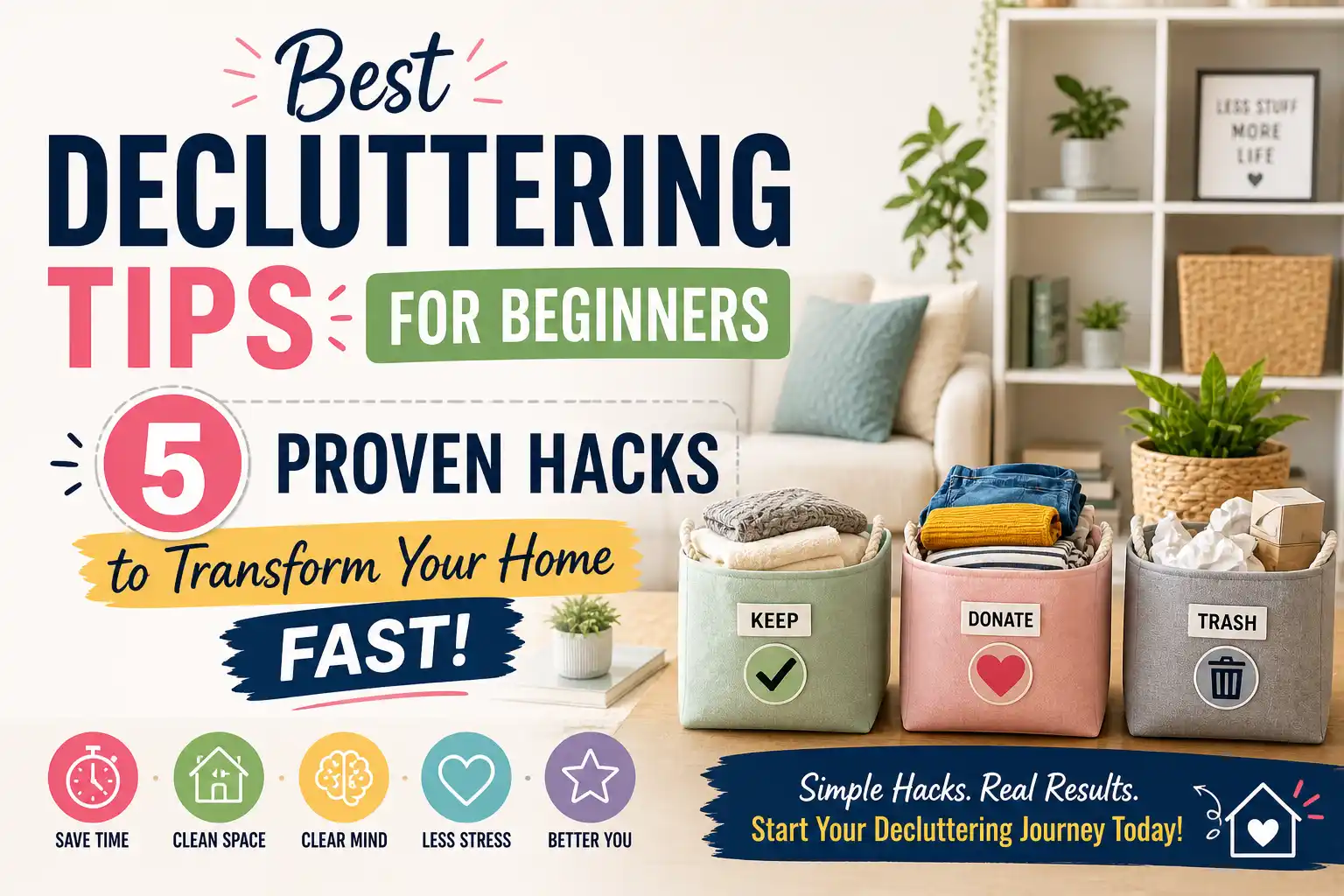
- Use the three-box method: Keep, Donate/Sell, Trash
- Focus on high-traffic areas like countertops first
- Follow the one-in, one-out rule to prevent future clutter
Top Beginner Tips for Decluttering
- Start with trash: remove expired, broken, or useless items
- Use a 15-minute timer daily
- Try the three-box method for fast decisions
- Clear visible surfaces first for instant motivation
- Don’t organize before decluttering
- Begin with non-sentimental items
Where to Start
- Fridge/pantry (expired food)
- Entryway (keys, bags, mail clutter)
- One junk drawer
How to Decide What to Keep
- Would I buy this again?
- Have I used it in 6–12 months?
- Use a “maybe box” for uncertain items
The Psychology Behind Clutter (Why We Keep Things We Don’t Need)
In my experience, clutter isn’t about laziness—it’s about decision fatigue and emotional attachment.
We keep things because:
- “I might need this someday”
- “I spent money on it”
- “It was a gift”
Even I held onto an old phone for years, not because I needed it, but because it felt wasteful to let it go.
But here’s the truth:
👉 Keeping things also costs you
- Space in your home
- Time organizing
- Mental energy
Once I realized that, letting go became easier.
See everything you need to know: How to Organize a Small Home & Maximize Your Space
Decluttering Tips for Beginners of All Time
Let’s break these into actionable categories so you can actually use them.
1. Mindset Shifts That Change Everything
✔ Stop Treating Your Home Like Storage
Your home isn’t a warehouse. If you’re keeping something “just in case,” ask yourself:
👉 Is it worth sacrificing peace and space?
✔ Give Yourself Permission to Buy Again
This one was a game changer for me.
I used to keep things out of fear—“What if I need it later?”
Now I tell myself: If I really need it, I’ll buy it again.
And guess what? I rarely do.
✔ Let Go of Gift Guilt
The value of a gift is in the moment, not the object.
Keeping something you don’t like doesn’t honor the giver—it just adds clutter.
✔ You Won’t Start Liking Something Later
That shirt you never wear? That lamp you hide in storage?
You already know the answer.
2. Decision-Making Frameworks (These Make It Easy)
✔ The “Best, Favorite, Necessary” Rule
Pick only:
- The best
- Your favorite
- What you actually need
Everything else? Optional.
✔ The “Useful or Beautiful” Test
If it’s neither functional nor meaningful… why keep it?
✔ The “Sparks Joy” Method
Popularized by Marie Kondo, this works surprisingly well.
I was skeptical at first, but it forces clarity fast.
✔ Ask: Would I Buy This Today?
If the answer is no, that’s your signal.
3. Proven Decluttering Systems That Actually Work
✔ The One-In, One-Out Rule
Every new item = one item removed.
Simple. Powerful. Effective.
✔ The 90/90 Rule
Ask yourself:
- Have I used it in the last 90 days?
- Will I use it in the next 90 days?
If not… let it go.
✔ The Hanger Trick (Closet Hack)
Turn all hangers backward.
After a few months, donate what you haven’t worn.
This one exposed my “fake favorite” clothes instantly.
✔ The Washi Tape Method (Kitchen Tools)
Mark items with tape.
If unused after months → remove them.
4. Practical Decluttering Techniques
✔ Declutter by Area (Not Everywhere at Once)
Finish one space completely.
Trust me, seeing one clean drawer feels amazing.
✔ The “Touch It Once” Rule
Handle items immediately:
- Sort mail instantly
- Put things away right away
This alone reduced my clutter by 30%.
✔ Pretend You’re Moving
Would you pack it, move it, and unpack it?
If not… why keep it?
✔ The “Ex Test” (Fun but Brutal)
Would you ask your ex to return this item?
No? Then it’s not that important
✔ The 10% Method
Reduce any category (shoes, books, clothes) by 10%.
It feels manageable and less painful.
🔁 5. Build Decluttering Habits That Last
✔ Keep a Donation Box Ready
Every time you find something unnecessary—drop it in.
✔ Limit Your Space
Assign boundaries:
- One drawer
- One shelf
When it’s full, something has to go.
✔ Do a Little Every Day
Consistency beats intensity.
Even 10 minutes daily works.
✔ Don’t Buy Organizers First
I made this mistake.
You don’t need bins—you need fewer things.
🏠 Step-by-Step Decluttering Plan for Beginners
If you’re starting from zero, follow this:
Step 1: Start Small
Pick:
- One drawer
- One shelf
- One surface
Step 2: Use the Three-Box Method
- Keep
- Donate
- Trash
Step 3: Remove Trash First
Instant progress = instant motivation.
Step 4: Focus on Visible Areas
Clear:
- Kitchen counters
- Tables
- Desks
This creates momentum.
Step 5: Move to Non-Sentimental Items
Start with:
- Clothes
- Papers
- Kitchen tools
Leave emotional items for later.
Common Decluttering Mistakes to Avoid
- Trying to do everything in one day
- Organizing instead of removing items
- Keeping things out of guilt
- Not having a system
- Burning out too fast
Quick Decluttering Cheat Sheet
- Start small
- Use a timer
- Ask better questions
- Focus on function + joy
- Build habits, not bursts
FAQs
What is the 3-3-3 rule for decluttering?
The 3-3-3 rule is a simple method to make decluttering less overwhelming.
👉 It means:
- Declutter 3 items per day, or
- Spend 3 minutes on 3 small areas, or
- Remove 3 items from 3 different spaces
💡 In my experience, this works great when you feel stuck or lazy. It’s so small that you can’t really avoid it—and once you start, you usually end up doing more.
What is the easiest way to declutter your home?
The easiest way is to start small and follow a simple system.
👉 Try this:
- Set a 15-minute timer
- Pick one small area (drawer, table, shelf)
- Use the three-box method (Keep, Donate, Trash)
💡 I’ve found that focusing on visible areas like countertops gives instant results and motivation.
What is the 5-5-5 rule for decluttering?
The 5-5-5 rule helps you make quick decisions.
👉 Ask yourself:
- Will I use this in 5 days?
- Will I use this in 5 months?
- Will I use this in 5 years?
If the answer is no to all three, it’s probably safe to let it go.
💡 This rule is especially helpful for items you feel unsure about.
What is the 27 decluttering hack?
The 27 decluttering hack is a fast-action method to remove clutter quickly.
👉 How it works:
- Walk around your home
- Find 27 items to throw away
- Then find 27 items to donate
💡 It turns decluttering into a small challenge. I’ve tried it—it’s surprisingly fun and effective when you need a quick reset.
What are the biggest decluttering mistakes?
Here are the most common mistakes people make:
❌ Trying to declutter everything at once
❌ Organizing instead of removing items
❌ Keeping things out of guilt
❌ Buying storage before decluttering
❌ Not having a clear system
💡 The biggest one I made? Buying storage bins before decluttering. I ended up organizing clutter instead of removing it.
What are the 4 C’s of decluttering?
The 4 C’s of decluttering is a simple decision-making system:
👉 Clear – Remove unnecessary items
👉 Categorize – Group similar items together
👉 Cut down – Reduce duplicates or extras
👉 Contain – Organize what’s left neatly
💡 This method works really well if you like structured systems and step-by-step processes.
How do I start decluttering if I feel overwhelmed?
Start with just one drawer or a 15-minute session. Small wins build momentum.
What should I declutter first?
Begin with:
- Trash
- Expired items
- Non-sentimental belongings
How long does decluttering take?
It depends, but most people see noticeable results within a few days of consistent effort.
How do I stop clutter from coming back?
Follow the one-in, one-out rule and be mindful of new purchases.
Conclusion: Decluttering Is a Skill
Decluttering isn’t about perfection, it’s about progress.
From my experience, the biggest shift happens when you stop asking:
👉 “What should I get rid of?”
And start asking:
👉 “What do I actually want in my life?”
Key Takeaways:
- Start small and stay consistent
- Use proven systems like 90/90 rule and one-in-one-out
- Focus on mindset as much as action
- Build habits to maintain results
Pros:
✔ More space
✔ Less stress
✔ Better focus
❌ Cons:
✖ Emotional decisions can