
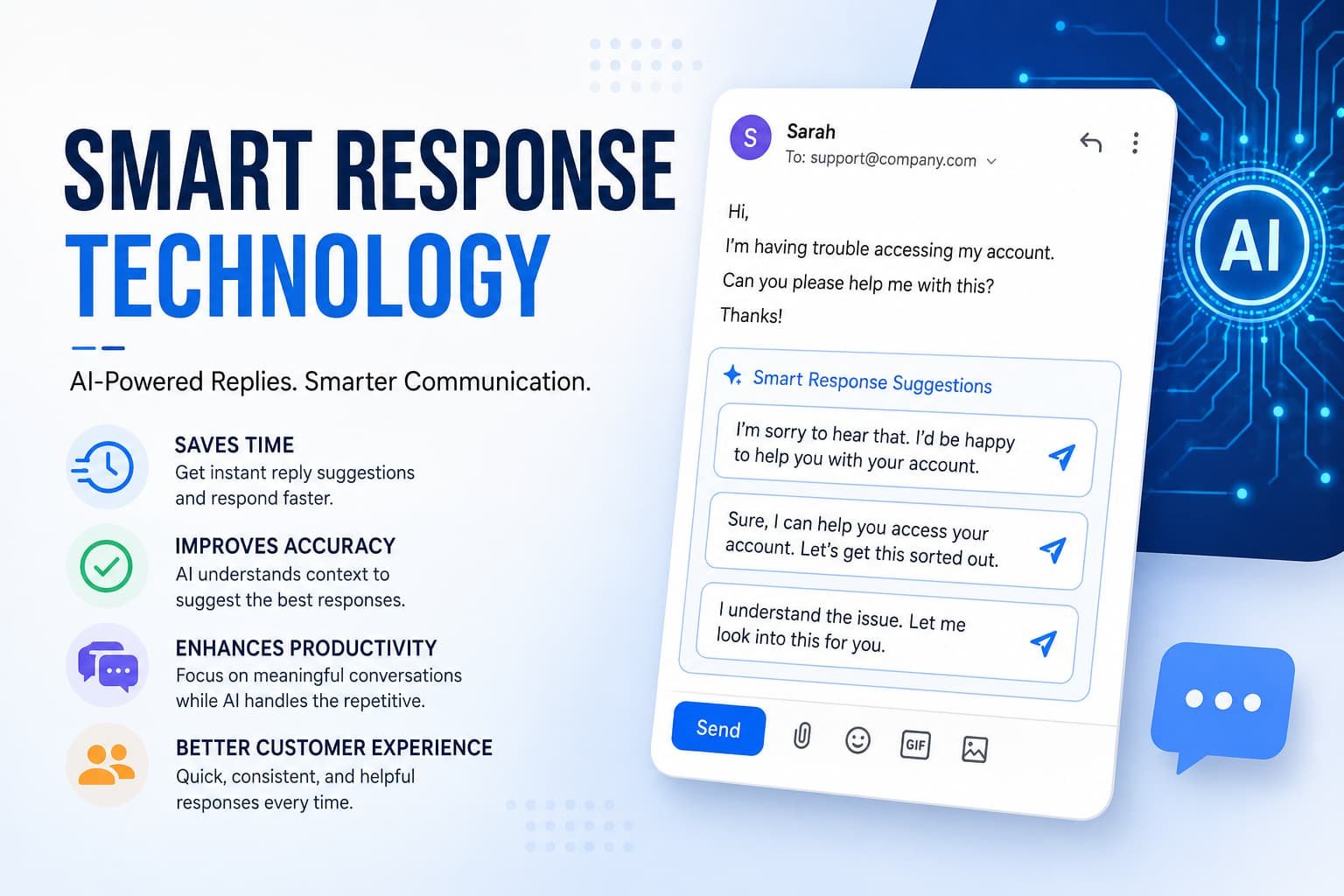
Have you ever noticed how email platforms, messaging apps, and customer service systems can suggest replies before you even start typing? Or how some support chatbots instantly provide accurate answers to common questions?
Behind many of these features is something known as smart response technology.
In my experience researching and testing various communication tools, smart response technology has evolved from a simple convenience feature into a powerful productivity tool. Whether you’re sending emails, managing customer support, or communicating through business applications, this technology is helping people save time while improving the quality and speed of interactions.
In this guide, I’ll explain what smart response technology is, how it works, where it’s used, and why it’s becoming increasingly important in both personal and professional communication.
What Is Smart Response Technology?
Smart response technology is an artificial intelligence (AI) system that automatically generates relevant replies, recommendations, or responses based on the context of a conversation, message, or user action.
The goal is simple:
- Reduce response time
- Improve communication efficiency
- Help users respond quickly
- Maintain conversation quality
- Automate repetitive interactions
Instead of manually typing every response, users can choose from AI-generated suggestions that match the context of the conversation.
For example, if someone emails you:
“Can we meet tomorrow at 2 PM?”
A smart response system might suggest:
- “Yes, that works for me.”
- “I’m available tomorrow.”
- “Can we reschedule for later?”
The technology analyzes the message and predicts the most appropriate replies.
Read More: What Is Industrial Technology?
How Does Smart Response Technology Work?
At its core, smart response technology combines several AI and machine learning techniques.
1. Natural Language Processing (NLP)
Natural Language Processing allows computers to understand human language.
The system analyzes:
- Sentence structure
- Keywords
- Intent
- Tone
- Context
For example, if someone asks a question, the system recognizes that a reply should provide an answer rather than a greeting.
2. Machine Learning Models
Machine learning algorithms are trained on large amounts of communication data.
These models learn patterns such as:
- Common replies
- Frequently asked questions
- Customer service interactions
- Email conversation structures
Over time, the system becomes better at predicting useful responses.
3. Context Analysis
Modern smart response tools don’t just analyze a single sentence.
They often evaluate:
- Previous messages
- Conversation history
- User preferences
- Business rules
- Customer information
This creates more relevant and personalized suggestions.
4. Response Ranking
Multiple responses are usually generated behind the scenes.
The system then ranks them based on factors like:
- Relevance
- Accuracy
- Confidence score
- User behavior patterns
The highest-ranked responses appear as suggestions.
A Simple Real-World Example
Let’s imagine a customer contacts an online store with this message:
“My order hasn’t arrived yet. Can you help?”
A traditional support agent would manually write a reply.
With smart response technology, the system may instantly suggest:
“I’m sorry for the delay. Let me check your order status.”
The support representative can send the response immediately or customize it before sending.
In testing customer service platforms, I’ve noticed this can significantly reduce response times while maintaining consistent service quality.
Common Applications of Smart Response Technology
Smart response technology appears in more places than many people realize.
Email Platforms
Many modern email services use smart replies.
Examples include:
- Suggested responses
- Automatic email drafting
- Follow-up reminders
- Meeting confirmation suggestions
This helps users process emails faster.
Customer Support Systems
Customer service teams frequently use smart response tools.
Benefits include:
- Faster ticket handling
- Consistent messaging
- Reduced workload
- Improved customer satisfaction
Agents spend less time typing repetitive responses.
Live Chat Systems
Businesses often integrate smart responses into chat support platforms.
The system can:
- Suggest replies to agents
- Provide chatbot responses
- Route conversations efficiently
This improves support speed and availability.
Messaging Applications
Smart responses are now common in messaging apps.
They help users quickly respond with:
- Confirmations
- Greetings
- Scheduling replies
- Common answers
Virtual Assistants
Digital assistants use smart response technology to answer questions and complete tasks.
Examples include:
- Voice assistants
- AI chatbots
- Smart home systems
- Enterprise productivity tools
Key Benefits of Smart Response Technology
After exploring several AI communication platforms, I found that the biggest advantages usually fall into five categories.
Faster Communication
Perhaps the most obvious benefit is speed.
Instead of typing full responses, users can:
- Select a suggestion
- Make minor edits
- Send instantly
This saves valuable time every day.
Increased Productivity
Employees can focus on more important tasks when routine communication is partially automated.
This is especially useful for:
- Customer service teams
- Sales departments
- Administrative staff
- Technical support teams
Consistent Messaging
Organizations often struggle to maintain consistent communication.
Smart response systems help by ensuring:
- Standardized language
- Accurate information
- Professional tone
- Brand consistency
Better Customer Experience
Customers generally appreciate quick responses.
Even when a human reviews the message before sending, smart response technology helps reduce wait times.
Reduced Human Error
Suggested responses can help minimize:
- Typos
- Missing information
- Incorrect wording
- Inconsistent answers
This improves communication quality overall.
Potential Challenges and Limitations
While smart response technology offers many benefits, it isn’t perfect.
Understanding its limitations helps users apply it more effectively.
Context Misunderstanding
AI can occasionally misunderstand complex conversations.
For example:
- Sarcasm
- Emotional situations
- Industry-specific terminology
- Ambiguous messages
Human review remains important.
Over-Automation
Some organizations become too dependent on automated responses.
This can make conversations feel:
- Robotic
- Impersonal
- Generic
A balance between automation and human interaction usually works best.
Privacy Concerns
Because these systems analyze communication data, organizations must ensure:
- Data protection
- Secure storage
- Compliance with regulations
- Responsible AI practices
Accuracy Risks
AI-generated suggestions may occasionally be inaccurate.
Users should verify important responses before sending them.
How Businesses Can Use Smart Response Technology Effectively
If you’re considering implementing smart response technology, I’ve found that a few best practices can make a significant difference.
Start With Repetitive Tasks
Identify communication that occurs repeatedly.
Examples include:
- Order status inquiries
- Appointment confirmations
- Password reset requests
- Common customer questions
These areas often provide the fastest return on investment.
Keep Human Oversight
Allow employees to review suggestions before sending them.
This ensures:
- Accuracy
- Personalization
- Context awareness
Monitor Performance
Track important metrics such as:
- Response time
- Customer satisfaction
- Resolution rates
- Agent productivity
These insights help optimize the system.
Continuously Train the AI
Many platforms improve through ongoing learning.
Regular updates help the system:
- Understand new scenarios
- Improve accuracy
- Adapt to changing customer needs
The Future of Smart Response Technology
The future looks incredibly promising.
Recent advances in artificial intelligence are making smart responses:
- More personalized
- More context-aware
- More conversational
- More accurate
Future systems may understand not only the words being used but also the user’s goals, emotions, and communication preferences.
In practical terms, this could lead to AI assistants that collaborate with humans rather than simply suggesting short replies.
We’re already seeing early versions of this in advanced AI-powered workplace tools.
Tips for Getting the Most Out of Smart Response Technology
If you’re using smart response tools today, here are some lessons I’ve learned:
- Always review suggestions before sending.
- Customize responses when needed.
- Use automation for routine tasks.
- Maintain a human tone in important conversations.
- Monitor accuracy regularly.
- Combine AI efficiency with human judgment.
- Keep customer experience as the primary focus.
These habits help maximize benefits while avoiding common pitfalls.
Conclusion
Smart response technology is an AI-driven system that generates relevant replies and communication suggestions based on the context of a conversation. By combining natural language processing, machine learning, and contextual analysis, it helps users communicate faster, more consistently, and more effectively.
From email platforms and messaging apps to customer support systems and virtual assistants, smart response technology is becoming a standard feature across digital communication channels.
In my experience, its greatest strength isn’t replacing human communication—it’s enhancing it. When used thoughtfully, it saves time, boosts productivity, and improves the overall communication experience while allowing people to focus on meaningful interactions.
As AI continues to evolve, smart response technology will likely become even more intelligent, personalized, and valuable. The key is to use it as a tool that supports human decision-making rather than replacing it entirely.