
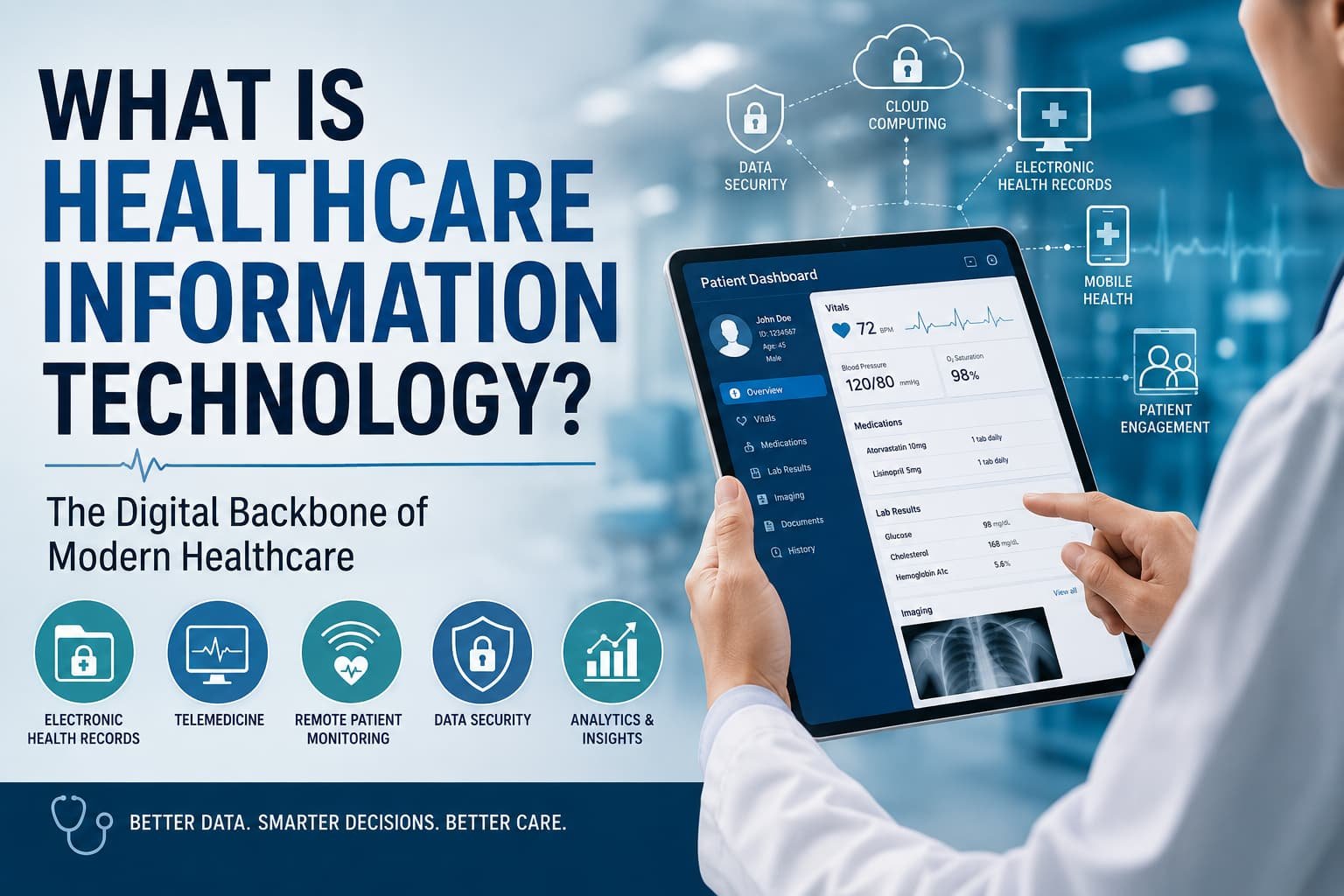
Have you ever visited a doctor and noticed that they instantly pulled up your medical history on a computer instead of digging through stacks of paper files?
A few years ago, I remember accompanying a family member to a specialist appointment. Within seconds, the doctor accessed lab reports, medication history, previous diagnoses, and imaging results from another healthcare facility. What would have taken days—or even weeks—in the past happened almost instantly.
That experience made me curious about the technology working behind the scenes. I started researching how hospitals, clinics, and healthcare providers manage massive amounts of patient data while delivering faster and safer care.
The answer lies in Healthcare Information Technology (Healthcare IT).
Healthcare Information Technology has become one of the most important innovations in modern medicine. It helps healthcare providers store, manage, share, and analyze patient information while improving efficiency and reducing errors.
In this guide, I’ll explain what healthcare information technology is, how it works, its benefits, challenges, real-world applications, and why it continues to reshape the future of healthcare.
What Is Healthcare Information Technology?
Healthcare Information Technology (HIT) refers to the use of computers, software, networks, databases, and digital systems to manage healthcare information and improve medical services.
Simply put, Healthcare IT combines healthcare and technology to make medical processes faster, more accurate, and more efficient.
These technologies help healthcare organizations:
- Store patient records digitally
- Manage appointments and billing
- Track medications
- Monitor patient health
- Improve communication between providers
- Analyze healthcare data
- Support clinical decision-making
Instead of relying on paper records and manual processes, healthcare facilities use digital tools to streamline operations and improve patient outcomes.
Read More: What Is DNA Synthesis Technology?
Why Healthcare Information Technology Matters
Healthcare generates enormous amounts of data every day.
Think about it:
- Patient histories
- Prescriptions
- Lab reports
- X-rays and scans
- Insurance claims
- Appointment schedules
- Treatment plans
Managing all this information manually would be overwhelming.
In my experience researching healthcare systems, one recurring issue appears again and again: information delays can directly affect patient care.
Healthcare IT solves this problem by ensuring that critical information is available when healthcare providers need it most.
The Main Components of Healthcare Information Technology
Healthcare IT isn’t just one system.
It’s an ecosystem of interconnected technologies working together.
Electronic Health Records (EHRs)
Electronic Health Records are digital versions of traditional patient files.
Popular EHR platforms include:
- Epic Systems
- Cerner (Oracle Health)
- Meditech
- eClinicalWorks
- Athenahealth
These systems store:
- Medical history
- Diagnoses
- Allergies
- Medications
- Test results
- Treatment plans
Instead of flipping through folders, doctors can access information with a few clicks.
Electronic Medical Records (EMRs)
Although often confused with EHRs, EMRs are slightly different.
EMRs generally contain patient records within a single healthcare practice, while EHRs can often be shared across multiple healthcare organizations.
Telemedicine Platforms
Telehealth exploded in popularity during recent years.
Healthcare IT powers virtual consultations through platforms that allow:
- Video appointments
- Secure messaging
- Remote diagnosis
- Digital prescriptions
Patients can receive care without traveling to a clinic.
Health Information Exchange (HIE)
Health Information Exchange systems allow healthcare organizations to securely share patient data.
For example:
A patient moves to another city.
Instead of repeating every test and procedure, the new doctor can often access previous medical records through HIE systems.
This saves time and reduces costs.
Clinical Decision Support Systems (CDSS)
These tools assist healthcare providers by analyzing patient data and suggesting evidence-based recommendations.
Examples include:
- Drug interaction alerts
- Treatment guidelines
- Diagnostic support
- Risk assessments
Think of them as intelligent assistants for healthcare professionals.
How Healthcare Information Technology Works
At its core, Healthcare IT collects, stores, processes, and shares health-related information.
The process typically looks like this:
Step 1: Data Collection
Information enters the system through:
- Patient registration
- Medical examinations
- Laboratory testing
- Medical devices
- Wearable technology
Step 2: Data Storage
The information is stored securely in databases and cloud systems.
Healthcare organizations must follow strict security standards to protect patient privacy.
Step 3: Data Analysis
Advanced software analyzes patient information to identify trends, risks, and treatment opportunities.
Step 4: Data Sharing
Authorized healthcare providers can access necessary information to deliver coordinated care.
The result?
Faster diagnoses, better treatment decisions, and improved patient experiences.
Real-World Examples of Healthcare Information Technology
Let’s move beyond definitions and look at practical examples.
Hospital Emergency Departments
Emergency physicians often need instant access to patient information.
Healthcare IT helps them quickly review:
- Allergies
- Medications
- Previous conditions
- Test results
When every second matters, fast access can make a significant difference.
Remote Patient Monitoring
Many patients now use devices that automatically transmit health information to providers.
Examples include:
- Blood pressure monitors
- Glucose monitors
- Heart rate trackers
- Smartwatches
Doctors can identify problems earlier without requiring frequent office visits.
Pharmacy Systems
Modern pharmacies rely heavily on healthcare IT.
Systems help:
- Verify prescriptions
- Detect drug interactions
- Manage inventory
- Reduce medication errors
I was skeptical at first about how much technology had entered pharmacies, but after seeing automated prescription verification systems in action, it’s easy to understand why they’re becoming standard.
Benefits of Healthcare Information Technology
Healthcare IT offers advantages for patients, providers, and healthcare organizations alike.
Improved Patient Safety
Digital systems reduce common medical errors.
Examples include:
- Incorrect medications
- Duplicate tests
- Missing allergy information
Built-in alerts help providers make safer decisions.
Better Care Coordination
Specialists, primary care physicians, nurses, and pharmacists can collaborate more effectively.
Everyone works from the same information source.
Increased Efficiency
Healthcare providers spend less time on paperwork and more time with patients.
Tasks such as scheduling, billing, and documentation become faster.
Cost Reduction
Healthcare IT can reduce costs through:
- Fewer duplicate tests
- Improved resource management
- Better workflow efficiency
- Reduced administrative expenses
Enhanced Patient Experience
Patients benefit from:
- Online appointment booking
- Patient portals
- Faster communication
- Easier access to records
Convenience matters, and Healthcare IT delivers it.
Common Challenges in Healthcare Information Technology
Despite its benefits, Healthcare IT isn’t perfect.
Cybersecurity Risks
Healthcare data is highly valuable.
As a result, hospitals and healthcare organizations face constant cybersecurity threats.
Strong security measures are essential to protect patient information.
Implementation Costs
Deploying large-scale Healthcare IT systems can be expensive.
Costs often include:
- Software licensing
- Hardware purchases
- Staff training
- System maintenance
Learning Curve
Healthcare professionals may require significant training when new systems are introduced.
Some employees adapt quickly, while others need additional support.
Interoperability Issues
Not all systems communicate perfectly with one another.
This can create challenges when sharing patient information across different organizations.
Emerging Trends in Healthcare Information Technology
The future of Healthcare IT looks incredibly exciting.
Artificial Intelligence
AI is increasingly helping healthcare providers:
- Analyze medical images
- Predict patient risks
- Support diagnoses
- Automate routine tasks
Cloud Computing
Cloud-based healthcare systems offer:
- Scalability
- Remote access
- Reduced infrastructure costs
Many healthcare organizations are shifting toward cloud solutions.
Wearable Health Technology
Devices such as smartwatches and fitness trackers continue generating valuable health data.
Healthcare providers can use this information to monitor patient health more effectively.
Predictive Analytics
Advanced analytics help identify potential health problems before they become serious.
Preventive care may become even more personalized in the coming years.
Quick Tips for Understanding Healthcare IT
If you’re new to the field, focus on these key concepts:
- Healthcare IT is about managing healthcare data digitally.
- Electronic Health Records are central to modern systems.
- Telemedicine relies heavily on Healthcare IT.
- Data security is a top priority.
- AI and analytics are shaping the future of healthcare.
Understanding these basics provides a strong foundation for exploring more advanced topics.
Frequently Asked Questions
What is the primary purpose of healthcare information technology?
The primary purpose is to improve healthcare delivery by managing, storing, analyzing, and sharing medical information more efficiently and accurately.
What is an example of healthcare information technology?
Electronic Health Records (EHRs) are among the most common examples. They allow healthcare providers to access patient information digitally rather than using paper records.
Is healthcare information technology a good career?
Yes. Healthcare IT is one of the fastest-growing sectors because healthcare organizations increasingly rely on technology. Careers include health informatics specialists, EHR analysts, healthcare data analysts, and IT security professionals.
How does healthcare IT improve patient care?
Healthcare IT improves patient care by reducing errors, enhancing communication, providing faster access to information, and supporting more informed clinical decisions.
What are the biggest challenges in healthcare IT?
Major challenges include cybersecurity risks, system integration issues, implementation costs, and ongoing staff training requirements.
Conclusion
Healthcare Information Technology has become the digital backbone of modern healthcare. From Electronic Health Records and telemedicine to artificial intelligence and predictive analytics, Healthcare IT helps providers deliver safer, faster, and more effective care.
In my experience researching the healthcare industry, one thing has become clear: technology is no longer a support tool—it is a core part of how healthcare operates. While challenges such as cybersecurity and system integration remain, the benefits often outweigh the obstacles.
The biggest advantage is simple: better information leads to better decisions. When healthcare professionals have immediate access to accurate patient data, everyone benefits.
As healthcare continues evolving, Healthcare Information Technology will play an even greater role in shaping the future of patient care, medical innovation, and healthcare efficiency.
Have you experienced telemedicine, patient portals, or digital health records firsthand? Share your thoughts and experiences—the future of healthcare is becoming more connected every day.