
In today’s digital world, technology is no longer just a support function—it has become the backbone of nearly every business operation. Whether a company uses cloud computing, cybersecurity tools, data analytics, artificial intelligence, or enterprise software, there must be a structured way to manage technology investments and risks. This is where Information Technology (IT) Governance comes into play.
When I first started exploring IT governance, I assumed it was simply another corporate compliance framework. I was skeptical at first, but after researching real-world business cases and governance models, I realized it plays a much bigger role. IT governance helps organizations ensure that technology supports business goals, reduces risk, improves accountability, and maximizes return on technology investments.
In this guide, I’ll explain what information technology governance is, why it matters, how it works, popular frameworks, common challenges, and practical examples that make the concept easier to understand.
What Is Information Technology Governance?
Information Technology Governance (IT Governance) is a framework of policies, processes, structures, and decision-making practices that ensure an organization’s technology supports its business objectives.
Simply put, IT governance helps answer questions such as:
- Are we investing in the right technology?
- Is our data secure?
- Are IT projects delivering value?
- Who is accountable for technology decisions?
- How do we manage technology-related risks?
IT governance creates alignment between business leadership and IT teams so that technology investments generate measurable business value.
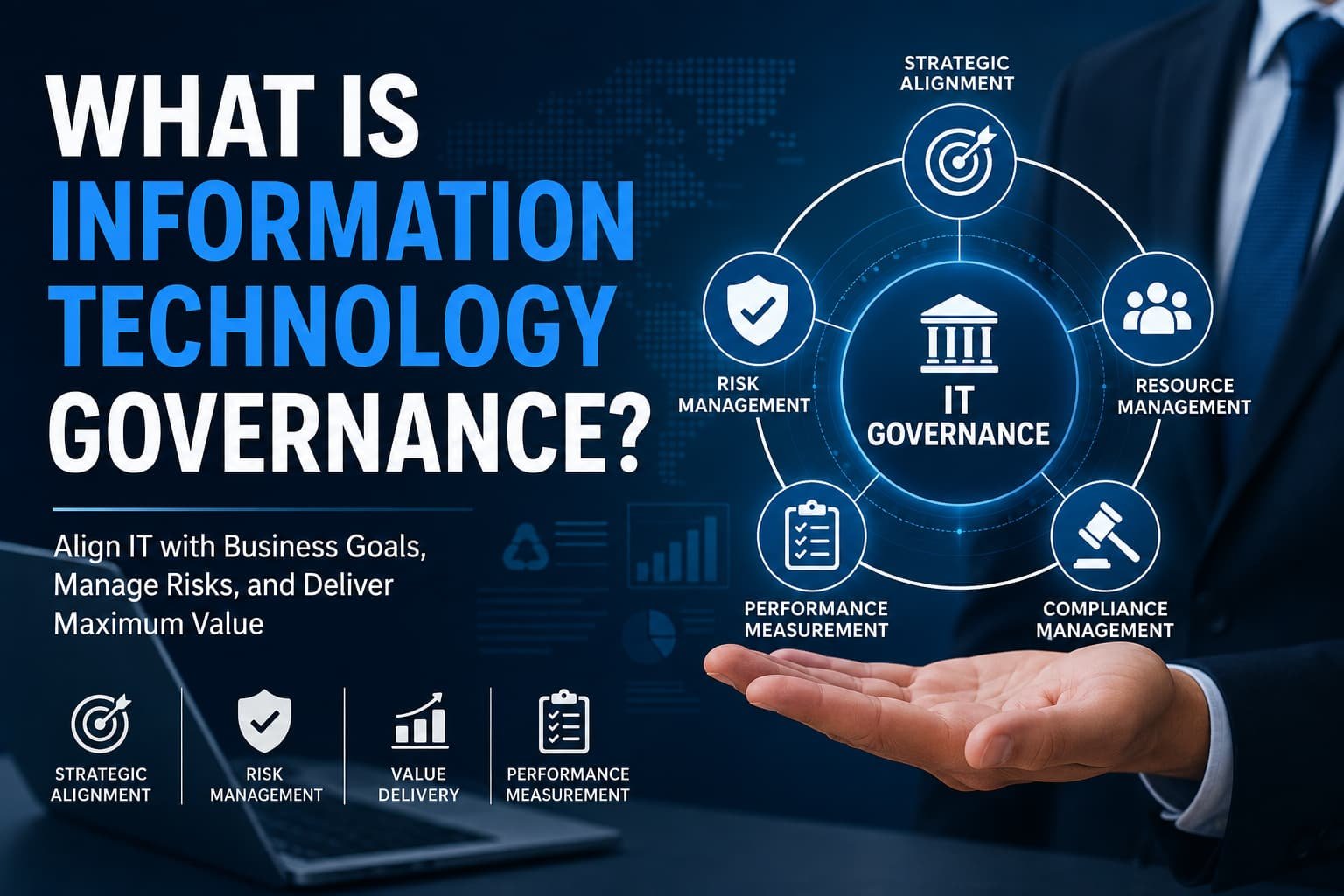
According to industry best practices, effective IT governance focuses on:
- Strategic alignment
- Value delivery
- Risk management
- Resource optimization
- Performance measurement
These pillars ensure that technology decisions contribute directly to organizational success.
See More: What Is Healthcare Information Technology?
Why IT Governance Matters
Many organizations spend millions on technology each year. Without governance, those investments can easily become inefficient or even harmful.
In my experience researching digital transformation projects, one recurring pattern stood out: organizations with strong governance frameworks consistently achieved better outcomes than those making technology decisions on an ad hoc basis.
Key Benefits of IT Governance
Better Business Alignment
Technology initiatives should support company objectives.
For example:
- A retail company may prioritize customer analytics.
- A healthcare provider may focus on data security.
- A financial institution may invest heavily in compliance systems.
IT governance ensures technology spending aligns with these priorities.
Improved Risk Management
Cybersecurity threats continue to increase every year.
Governance helps organizations:
- Identify vulnerabilities
- Establish security policies
- Monitor compliance requirements
- Prepare incident response plans
Increased Accountability
Without clear ownership, projects often fail.
IT governance defines:
- Decision makers
- Responsibilities
- Approval processes
- Performance expectations
This clarity reduces confusion and improves execution.
Higher Return on Investment (ROI)
Technology projects can be expensive.
Governance helps organizations evaluate:
- Expected benefits
- Project costs
- Business impact
- Long-term value
This prevents wasteful spending on unnecessary technologies.
Core Components of Information Technology Governance
Effective IT governance consists of several interconnected components.
Strategic Alignment
Strategic alignment ensures technology initiatives support business goals.
For example, if a company’s goal is to improve customer experience, IT investments might focus on:
- CRM systems
- Customer support platforms
- Mobile applications
- Data analytics tools
Without alignment, technology becomes an isolated function rather than a business enabler.
Risk Management
Every technology decision introduces potential risks.
Common IT risks include:
- Data breaches
- System outages
- Regulatory violations
- Vendor dependency
- Human error
Governance frameworks establish procedures to identify, assess, and mitigate these risks.
Performance Measurement
Organizations must evaluate whether technology investments are producing results.
Common metrics include:
Operational Metrics
- System uptime
- Incident response times
- Service availability
Financial Metrics
- Cost savings
- ROI
- Budget utilization
Business Metrics
- Customer satisfaction
- Revenue growth
- Productivity improvements
Regular measurement helps leaders make informed decisions.
Resource Management
Technology resources include:
- Employees
- Infrastructure
- Software
- Cloud services
- Budgets
Governance ensures these resources are allocated effectively to support strategic priorities.
Compliance Management
Many industries face strict regulatory requirements.
Examples include:
- GDPR
- HIPAA
- PCI DSS
- ISO standards
IT governance helps organizations maintain compliance while reducing legal and financial risks.
Popular IT Governance Frameworks
Organizations often use established frameworks to guide governance practices.
COBIT
COBIT (Control Objectives for Information and Related Technologies) is one of the most widely recognized IT governance frameworks.
It helps organizations:
- Align IT with business goals
- Manage risks
- Improve performance
- Establish governance controls
Many enterprises use COBIT as the foundation of their governance programs.
ITIL
ITIL (Information Technology Infrastructure Library) focuses primarily on IT service management.
It provides best practices for:
- Incident management
- Change management
- Service delivery
- Continuous improvement
ITIL complements governance efforts by improving operational efficiency.
ISO/IEC 38500
This international standard provides guidance for directors and executives regarding effective governance of IT.
Its principles emphasize:
- Responsibility
- Strategy
- Acquisition
- Performance
- Conformance
- Human behavior
NIST Cybersecurity Framework
Organizations prioritizing cybersecurity often use the NIST framework to strengthen governance and risk management processes.
Key functions include:
- Identify
- Protect
- Detect
- Respond
- Recover
How IT Governance Works in Practice
Let’s consider a practical example.
Imagine a growing e-commerce company planning to implement a new cloud platform.
Without governance:
- Departments select different tools independently.
- Security requirements are inconsistent.
- Costs increase unexpectedly.
- Integration problems emerge.
With governance:
- Leadership evaluates business goals.
- Security requirements are defined.
- Budget approvals follow a structured process.
- Performance metrics are established.
As a result, the project is more likely to succeed.
This simple example demonstrates how governance transforms technology decisions from reactive choices into strategic investments.
Common Challenges in IT Governance
Although governance offers significant benefits, implementation isn’t always easy.
Resistance to Change
Employees may view governance as unnecessary bureaucracy.
One common misconception is that governance slows innovation.
In reality, effective governance creates a framework that allows innovation to happen safely and efficiently.
Lack of Executive Support
Governance initiatives often fail when leadership isn’t fully committed.
Executive sponsorship is critical because governance affects multiple departments and strategic decisions.
Poor Communication
Business leaders and IT teams sometimes speak different “languages.”
Governance requires strong communication channels to ensure everyone understands objectives and expectations.
Rapid Technology Changes
New technologies emerge constantly.
Cloud computing, AI, machine learning, and automation create opportunities but also introduce new governance challenges.
Organizations must continuously update policies and governance practices to remain effective.
IT Governance vs IT Management
Many people confuse governance with management.
They are related but distinct concepts.
IT Governance
Focuses on:
- Decision-making
- Oversight
- Strategic direction
- Accountability
Asks:
“Are we doing the right things?”
IT Management
Focuses on:
- Daily operations
- Project execution
- Service delivery
- Technical implementation
Asks:
“Are we doing things right?”
Governance sets the direction, while management executes the plan.
Both are essential for organizational success.
Best Practices for Effective IT Governance
Organizations looking to strengthen governance should consider the following practices.
Establish Clear Policies
Document:
- Security policies
- Technology standards
- Approval procedures
- Risk management processes
Clear guidelines improve consistency.
Define Roles and Responsibilities
Everyone should understand:
- Who makes decisions
- Who approves investments
- Who manages risks
- Who monitors performance
Accountability drives better outcomes.
Measure Performance Regularly
Track meaningful metrics and review them consistently.
Data-driven governance helps leaders make informed decisions.
Prioritize Cybersecurity
Modern governance cannot ignore cybersecurity.
Security should be integrated into every technology decision rather than treated as an afterthought.
Encourage Continuous Improvement
Technology evolves rapidly.
Governance frameworks should be reviewed and refined regularly to remain effective.
The Future of Information Technology Governance
The future of IT governance is closely tied to emerging technologies.
Organizations increasingly rely on:
- Artificial Intelligence (AI)
- Cloud Computing
- Internet of Things (IoT)
- Big Data Analytics
- Automation Platforms
As these technologies become more important, governance frameworks must evolve to address:
- AI ethics
- Data privacy
- Algorithm transparency
- Third-party risks
- Digital resilience
Forward-thinking organizations are already adapting their governance strategies to prepare for these challenges.
Quick Tips for Improving IT Governance
If you’re just getting started, here are a few practical tips:
- Align every technology investment with a business objective.
- Create clear accountability for IT decisions.
- Monitor cybersecurity risks continuously.
- Use governance frameworks like COBIT or ITIL.
- Review technology performance regularly.
- Involve executive leadership in governance discussions.
- Treat governance as an ongoing process rather than a one-time project.
Conclusion
Information Technology Governance is the system that ensures technology supports business goals while managing risks and maximizing value. It provides the structure, accountability, and oversight needed to make smarter technology decisions.
After studying numerous governance frameworks and real-world examples, one thing became clear: organizations that govern technology effectively are often better positioned to innovate, compete, and adapt to change.
Whether you’re a business leader, IT manager, cybersecurity professional, or student, understanding IT governance is becoming increasingly important in today’s technology-driven environment.
The goal isn’t to create unnecessary rules—it’s to ensure technology works for the business rather than against it.
And let’s be honest, avoiding a multimillion-dollar technology mistake is usually worth a few governance meetings.
Frequently Asked Questions (FAQ)
1. What is the main purpose of IT governance?
The primary purpose of IT governance is to ensure technology investments support business objectives while managing risks, improving accountability, and delivering value.
2. What are the key components of IT governance?
The main components include strategic alignment, risk management, performance measurement, resource management, and compliance management.
3. What is the difference between IT governance and IT management?
IT governance focuses on oversight, accountability, and strategic decision-making, while IT management focuses on implementing and operating technology solutions on a day-to-day basis.