
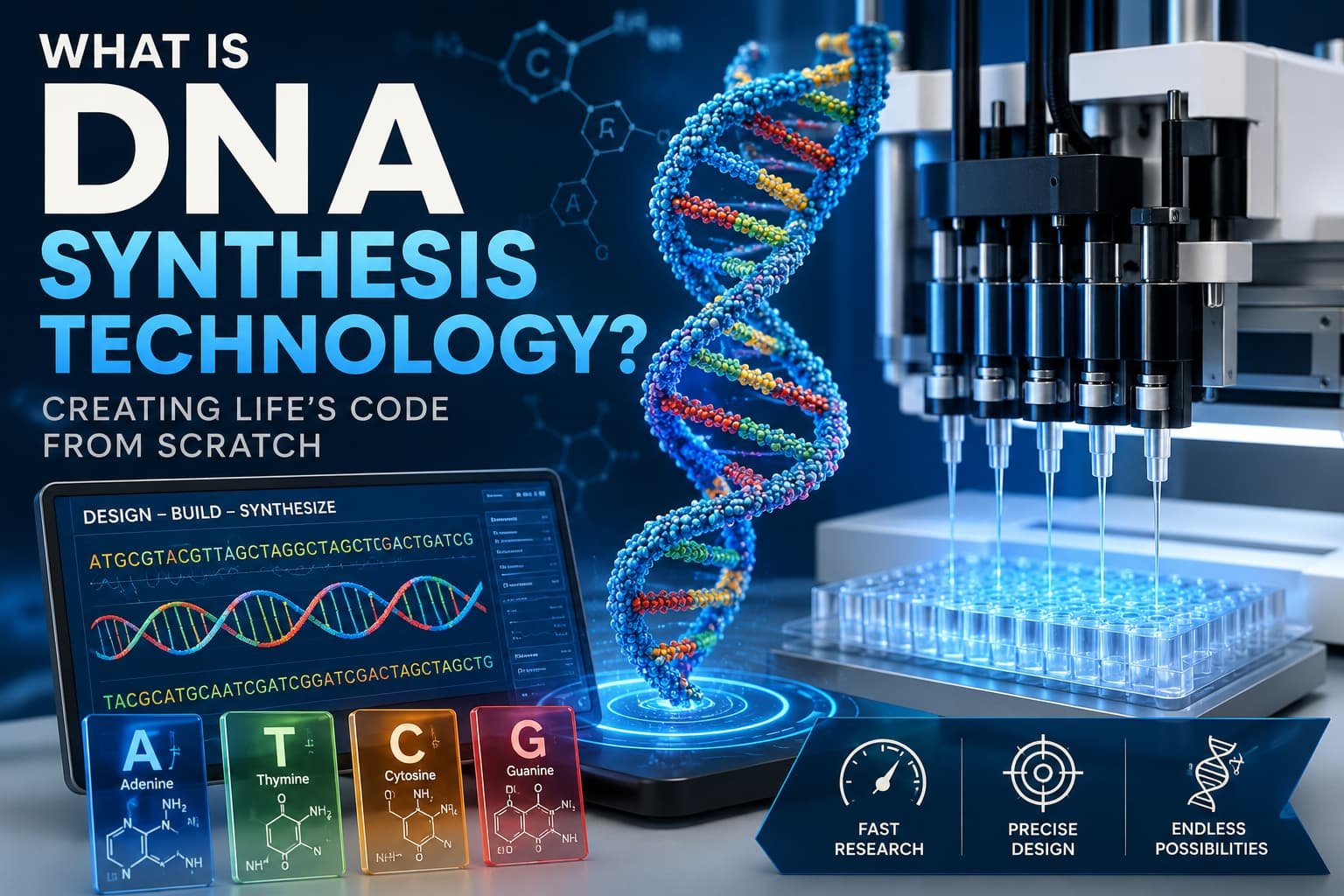
DNA is often called the blueprint of life. Every living organism—from tiny bacteria to humans—relies on DNA to store genetic instructions. But what if scientists could design and create DNA sequences from scratch instead of simply studying what already exists in nature?
This is exactly where DNA synthesis technology comes in.
When I first started exploring this field, I was fascinated by the idea that researchers could essentially “write” genetic code in a laboratory much like programmers write software code. The deeper I researched, the more I realized that DNA synthesis technology is transforming medicine, biotechnology, agriculture, and scientific research at an incredible pace.
In this guide, I’ll explain what DNA synthesis technology is, how it works, why it matters, and where it is heading in the future—all in simple, easy-to-understand language.
Understanding DNA Synthesis Technology
DNA synthesis technology refers to the artificial creation of DNA molecules in a laboratory.
Instead of extracting DNA from living organisms, scientists chemically build DNA sequences nucleotide by nucleotide. These sequences can be designed to match naturally occurring genes or entirely new genetic instructions created for specific purposes.
Think of DNA as a sentence written with four letters:
- A (Adenine)
- T (Thymine)
- C (Cytosine)
- G (Guanine)
DNA synthesis technology allows scientists to arrange these letters in virtually any order they need.
This capability has opened doors to groundbreaking innovations in:
- Drug development
- Vaccine research
- Genetic engineering
- Synthetic biology
- Agricultural improvements
- Disease diagnostics
See More: What Is Computer Systems Technology?
Why DNA Synthesis Technology Is Important
Before DNA synthesis became widely available, researchers often had to isolate genes from existing organisms, which could be slow and complicated.
Today, scientists can simply design a desired sequence on a computer and have it synthesized in a laboratory.
In my experience researching biotechnology trends, this shift is similar to the evolution of manufacturing. Instead of searching for a natural resource, researchers can now create exactly what they need.
Some major benefits include:
- Faster scientific research
- Greater precision
- Reduced development time
- Custom genetic design
- Improved experimental reproducibility
This efficiency is one reason DNA synthesis has become a cornerstone of modern biotechnology.
How DNA Synthesis Technology Works
The process may sound complex, but the basic concept is surprisingly straightforward.
Step 1: Designing the DNA Sequence
Scientists first determine the DNA sequence they need.
Specialized software helps researchers:
- Design genes
- Optimize genetic codes
- Eliminate unwanted mutations
- Predict biological behavior
This digital design serves as the blueprint for synthesis.
Step 2: Chemical Assembly
The DNA sequence is then built using chemical reactions.
Small DNA fragments called oligonucleotides are created first. These short pieces usually contain between 20 and 200 nucleotides.
Scientists carefully add nucleotides one at a time in the correct order.
Step 3: Fragment Assembly
Long genes cannot usually be synthesized in a single step.
Instead, smaller fragments are joined together using molecular biology techniques.
The assembled sequence is then checked for accuracy.
Step 4: Verification and Quality Control
Quality control is critical.
Researchers use DNA sequencing technologies to verify that:
- The sequence matches the design
- No unwanted mutations exist
- The DNA functions correctly
Only after verification is the synthesized DNA used in experiments or commercial applications.
Types of DNA Synthesis
DNA synthesis technology generally falls into two categories.
1. Oligonucleotide Synthesis
This involves creating short DNA strands.
Common uses include:
- PCR primers
- Gene editing tools
- Diagnostic tests
- Research experiments
These short sequences are produced quickly and relatively inexpensively.
2. Gene Synthesis
Gene synthesis involves creating complete genes or larger DNA constructs.
Applications include:
- Protein production
- Vaccine development
- Synthetic biology projects
- Industrial biotechnology
Gene synthesis is more complex but provides significantly greater flexibility.
Real-World Applications of DNA Synthesis Technology
One of the most exciting aspects of DNA synthesis is its broad range of applications.
Let’s explore some of the most important examples.
Medicine and Healthcare
DNA synthesis is revolutionizing healthcare.
Researchers can design synthetic genes to:
- Develop vaccines
- Produce therapeutic proteins
- Create gene therapies
- Improve disease detection
The rapid development of modern vaccines demonstrated how quickly synthetic genetic technologies can support public health responses.
Drug Discovery
Pharmaceutical companies use synthesized DNA to study diseases and identify new treatments.
Benefits include:
- Faster screening of drug candidates
- Improved accuracy
- Reduced research costs
This accelerates the path from laboratory discovery to patient treatment.
Synthetic Biology
Synthetic biology combines engineering principles with biology.
Scientists can create biological systems that perform specific tasks such as:
- Producing biofuels
- Manufacturing chemicals
- Detecting environmental contaminants
In many ways, synthetic biology treats DNA as a programmable language.
Agriculture
DNA synthesis technology is helping improve agriculture worldwide.
Researchers use synthetic genes to develop crops that are:
- More drought-resistant
- More disease-resistant
- Higher yielding
- Better adapted to changing climates
These innovations can contribute to food security as global populations continue to grow.
Diagnostic Testing
Many modern diagnostic tools rely on synthetic DNA.
Applications include:
- Infectious disease testing
- Genetic screening
- Cancer detection
- Personalized medicine
Synthetic DNA helps improve testing accuracy and reliability.
DNA Synthesis and Gene Editing: What’s the Difference?
People often confuse DNA synthesis with gene editing, but they are different technologies.
DNA synthesis focuses on creating new DNA sequences from scratch.
Gene editing focuses on modifying existing DNA inside an organism.
A simple analogy helps explain the difference:
- DNA synthesis is writing a completely new document.
- Gene editing is revising an existing document.
Both technologies often work together, especially in advanced genetic research.
Advantages of DNA Synthesis Technology
After reviewing numerous scientific studies and industry developments, several advantages consistently stand out.
Speed
Researchers can obtain custom DNA much faster than traditional cloning methods.
Precision
Designed sequences can be tailored for highly specific objectives.
Flexibility
Scientists are not limited by naturally occurring genetic material.
Scalability
Large-scale production supports commercial and industrial applications.
Innovation Potential
DNA synthesis enables entirely new biological solutions that may not exist in nature.
These strengths explain why demand for synthetic DNA continues to grow globally.
Challenges and Limitations
Despite its promise, DNA synthesis technology still faces several challenges.
Cost
Although prices have fallen dramatically over the years, synthesizing large DNA sequences can still be expensive.
Accuracy
Even small errors in DNA sequences can affect biological function.
Continuous quality control is essential.
Technical Complexity
Long DNA sequences remain more difficult to synthesize than shorter ones.
Ethical Considerations
As with many powerful technologies, responsible use is important.
Researchers and regulators continue to address questions related to:
- Biosecurity
- Genetic privacy
- Environmental impact
- Ethical genetic engineering
Balanced oversight helps ensure safe and beneficial applications.
The Future of DNA Synthesis Technology
The future looks incredibly promising.
Experts expect continued advancements in:
- Automated DNA manufacturing
- Artificial intelligence-assisted design
- Personalized medicine
- Synthetic organisms
- Gene therapies
One trend I find particularly interesting is the effort to dramatically reduce DNA synthesis costs. Some researchers compare today’s DNA synthesis industry to the early days of computer technology—expensive at first but becoming increasingly accessible over time.
As costs decrease and capabilities improve, more industries will likely adopt synthetic DNA solutions.
Future possibilities may include:
- Customized medical treatments
- Environmentally friendly manufacturing
- Advanced disease prevention
- Sustainable agricultural systems
- Novel biological products
What once sounded like science fiction is steadily becoming reality.
Practical Takeaways for Beginners
If you’re new to DNA synthesis technology, remember these key points:
- DNA synthesis creates genetic material artificially in a laboratory.
- Scientists build DNA sequences nucleotide by nucleotide.
- The technology supports medicine, agriculture, research, and biotechnology.
- Synthetic DNA can be customized for specific applications.
- Costs are decreasing while capabilities continue to expand.
- Ethical and safety considerations remain important.
- The technology is expected to play a major role in future scientific innovation.
Understanding these fundamentals provides a strong foundation for exploring more advanced topics in genetics and biotechnology.
Conclusion
DNA synthesis technology is one of the most transformative innovations in modern science. By enabling researchers to create DNA sequences from scratch, it has accelerated discoveries across medicine, agriculture, biotechnology, and countless other fields.
From developing life-saving therapies to engineering more resilient crops, the applications continue to expand. In my experience studying emerging technologies, few areas demonstrate as much potential for long-term impact as synthetic DNA.
As the technology becomes faster, cheaper, and more precise, its influence on science and society will only continue to grow. For anyone interested in the future of biology, understanding DNA synthesis technology is an excellent place to start.