How Much Gravel Do I Need?
Ordering too little gravel is the most expensive mistake in a landscaping project, because the stone itself is cheap and the second delivery is not. A short order means another delivery fee, another day lost, and a half finished surface sitting open while you wait for the truck. Ordering far too much is only slightly better, since you pay for stone you will never spread and then have to store or give away. This guide shows you how to calculate how much gravel you need for any project, in cubic yards and in tons, with worked examples you can check against your own measurements.
The method below is the same one quarries and landscape suppliers use, and it only needs three numbers from you: the length and width of your area, and the depth of gravel you plan to spread. Once you have those three numbers, the rest is simple arithmetic that you can do on a phone calculator in under a minute. You will also learn how depth, density, compaction, and waste change the final order, so the number you give your supplier is the number that actually finishes the job.

The Short Answer: The Formula in 30 Seconds
If you only want the formula, here it is. Multiply length by width by depth (with depth converted from inches to feet) to get cubic feet, then divide by 27 to get cubic yards, then multiply cubic feet by the material density and divide by 2,000 to get tons. That is the whole calculation, and everything else on this page is about getting the three inputs right and adjusting for the real world. Most wrong orders come from a wrong depth or a wrong density, not from the arithmetic itself, so read the depth and density sections before you call the yard.
A quick example makes the formula concrete. A patio measuring 10 feet by 10 feet with gravel 3 inches deep gives 100 times 0.25, which is 25 cubic feet, and 25 divided by 27 is 0.93 cubic yards. At a typical gravel density of 105 pounds per cubic foot, that same volume weighs 2,625 pounds, or about 1.3 tons. Add the standard 10 percent waste buffer and the order becomes about 1.4 tons, a number small enough for bags but cheap enough in bulk to justify a delivery if you have other work planned.
How to Calculate Gravel in Yards
Figuring gravel in cubic yards is the starting point because yards measure volume, and volume is what fills a space. The steps are simple, but each one has a trap that catches first time buyers. First, measure the length and width of your area in feet, measuring the widest points rather than the neatest ones, because a surface that is 12 feet wide at one end and 13 at the other needs the larger number. Second, convert your depth from inches to feet by dividing by 12, so 4 inches becomes 0.333 feet and 3 inches becomes 0.25 feet. Third, multiply length times width times depth in feet to get cubic feet, then divide by 27 to convert to cubic yards.
Here is a full driveway example so you can check your own sums. A driveway 12 feet wide and 40 feet long with 4 inches of gravel gives 12 times 40 times 0.333, which is 160 cubic feet. Dividing 160 by 27 gives 5.93 cubic yards, which you would round up to 6 yards when ordering. That 6 yard figure is the raw volume with no margin, and the waste and compaction sections below explain why you should not order exactly that number. If you are figuring gravel for a driveway specifically, our gravel driveway calculator walks through the layered build with a base course and a top course in one pass.
The most common error in this step is typing inches as feet. Entering 4 instead of 0.333 makes the answer twelve times too large, and entering a depth in inches into a calculator that expects feet has the same effect. The second most common error is measuring only the tire tracks on an existing driveway instead of the full surface including the edges, which always spread wider than the driving line. Measure the finished surface you want, not the worn path you have, and add a foot of width on each side for edge spread on a new loose surface.
How to Calculate Tons of Gravel
Suppliers usually sell by the ton, so after finding cubic yards you need to convert to weight, and that conversion depends on material density. The formula is simple: tons equal cubic feet times density in pounds per cubic foot, divided by 2,000. A short ton is 2,000 pounds, which is the ton used by US suppliers, and it is not the same as a metric tonne of 2,204 pounds. Using the site’s master densities keeps every page on this site consistent, so the same project always gives the same answer whichever calculator you use.
| Material | Density lb/ft3 | Tons per cubic yard |
|---|---|---|
| Gravel (general) | 105 | 1.42 |
| Pea gravel | 96 | 1.30 |
| Crushed stone #57 | 105 | 1.42 |
| Crusher run | 135 | 1.82 |
| River rock | 105 | 1.42 |
| Bank-run gravel | 130 | 1.76 |
| Decomposed granite | 125 | 1.69 |
Figuring tons of gravel is where most orders go wrong, because one density does not fit every stone. Crusher run is about 20 percent heavier per yard than washed #57 stone, because its fines fill the air gaps between the larger pieces, so a 25 ton order calculated with the wrong density can be five tons short. River rock and pea gravel sit lower, near 1.3 tons per yard, while bank-run gravel sits higher at about 1.76 tons per yard. When your supplier publishes their own density for the exact product on the ticket, use theirs instead of any generic table, since quarry source and moisture move the real number a few percent either way.
Return to the driveway example to see the conversion in action. The 160 cubic feet from the previous section, multiplied by 105 pounds per cubic foot for crushed stone #57, gives 16,800 pounds. Dividing 16,800 by 2,000 gives 8.4 tons, and adding the standard 10 percent buffer brings the order to about 9.2 tons. That is the number to give the supplier for a single 4 inch layer of #57 stone over a 12 by 40 foot driveway. If you are learning how to calculate tons of gravel for a layered driveway, calculate each layer separately with its own density, because a crusher run base and a #57 top layer do not weigh the same per yard.
How Much Gravel for Common Projects
Different projects need very different depths, and depth changes the total more than any other input. The table below gives realistic starting points for the projects homeowners ask about most, using crushed stone #57 at 105 pounds per cubic foot. These are planning figures for a single layer at the stated depth, before the waste buffer, so add 10 percent to each result before ordering. For layered driveways, calculate the base and the top separately and add them together rather than averaging the depths.
| Project | Typical size | Depth | Cubic yards | Tons before buffer |
|---|---|---|---|---|
| Driveway top layer | 12 x 40 ft | 4 in | 5.93 | 8.4 |
| Garden path | 3 x 30 ft | 3 in | 0.83 | 1.2 |
| Decorative bed | 10 x 10 ft | 3 in | 0.93 | 1.3 |
| Patio area | 12 x 12 ft | 3 in | 1.33 | 1.9 |
| French drain trench | 1 x 30 ft | 12 in | 1.11 | 1.6 |
| Shed base | 12 x 14 ft | 4 in | 2.07 | 2.9 |
| Playground area | 10 x 12 ft | 6 in | 2.22 | 3.1 |
A shed base deserves a special note, because the pad should extend about a foot beyond the shed on every side, and about two feet is better if you want a working edge. A 10 by 12 foot shed therefore needs a 12 by 14 foot pad, which is the size used in the table above. For a garden bed, the same math applies, but remember that beds are usually measured to the inside of the edging, and edging that leans outward after filling will quietly steal area. Measure inside the finished edging line, not the rough outline you marked with a hose.
Measuring Rectangles, Circles, and Irregular Shapes
A rectangle is the easiest shape, and it is just length times width in feet. A circle uses 3.14 times the radius times the radius, where the radius is half the diameter, so a 10 foot diameter bed gives 3.14 times 25, which is 78.5 square feet. A triangle uses half the base times the height, which covers most corner beds and angled path sections. For any other shape, split it into rectangles and triangles, calculate each piece, and add the results together, because a shape measured as one big rectangle always overstates the area.
Slopes and uneven ground need a different habit, and that habit is averaging depth readings. Measure the depth in five or six spots across the area, including the high and low points, and use the average rather than the single deepest or shallowest reading. Real ground is never as flat as it looks, and low spots swallow extra stone while high spots need almost none. On a slope, order the extra material at the downhill end, where loose stone migrates, and consider a slightly higher waste buffer, because gravity will keep moving your surface after you spread it.
Depth Guide: How Deep Should Gravel Be?
Depth is the input people guess most often, and guessing it wrong is the fastest way to a short order. Decorative beds and garden paths need only 2 to 3 inches, because the stone is there to look good and suppress weeds, not to carry weight. Walkways and patios need 3 to 4 inches, with a compacted base underneath if the surface will see regular foot traffic or furniture. A residential driveway needs 4 inches of compacted base as an absolute minimum, and a proper layered driveway runs 8 to 12 inches across two or three courses on soft ground.
| Project | Recommended depth |
|---|---|
| Decorative bed or mulch alternative | 2 to 3 in |
| Garden path or walkway | 2 to 3 in |
| Patio or seating area | 3 to 4 in |
| Light driveway, passenger cars only | 4 in base plus 2 to 3 in top |
| Heavy driveway, trucks or RVs | 6 in base plus 2 to 3 in top |
| French drain | 12 in around the pipe |
| Shed or greenhouse base | 4 to 6 in |
| Playground surface | 9 to 12 in loose, 6 in compressed |
Deeper is not always better, and that warning matters for drainage and for cost. Stone piled deeper than the project needs does not drain better, it just costs more and migrates further, and a decorative bed deeper than 3 inches can actually smother the soil beneath it. For driveways, the extra depth belongs in the base layer, not in the decorative top layer, because the base is what carries the load. If you are unsure, measure the depth of a neighbour’s driveway that has survived several winters, since local practice usually reflects local soil.

Compaction and Settling: Why Orders Come Up Short
Loose stone and compacted stone are not the same volume, and that difference is the quiet reason many orders come up short. A layer of loose gravel shrinks by roughly 10 to 20 percent when it is compacted, and crusher run base layers shrink by 15 to 25 percent, because the fines settle into the gaps between the larger pieces. That means a driveway calculated at 4 inches loose will finish closer to 3 inches compacted unless you order the extra material. The waste buffer exists precisely to cover this gap, and skipping it is the same as planning to be short.
Settling continues after compaction, especially on fresh or soft subgrade, where stone slowly presses into the soil over the first wet season. Landscape fabric, also called geotextile, slows this process by keeping the stone and the soil apart, and it is cheap insurance under any driveway or path. Without fabric, the first few tons of a new driveway can simply disappear into mud, and no calculator can account for stone that sank. Put the fabric down first, overlap the seams by at least a foot, and only then spread the stone.
The 10 Percent Waste Buffer, Explained
The standard advice is to add 10 percent to your calculated order, and that advice survives because it matches real job sites. Ten percent covers spillage off the edges, uneven subgrade, the compaction shrinkage described above, and the small pile you will inevitably lose to the wheelbarrow and the lawn. On sloped, irregular, or freshly graded ground, raise the buffer to 15 percent, because those sites waste more stone in every direction. For a compacted crusher run base layer, use 15 to 25 percent, since compaction alone eats that much volume before a single tire rolls over it.
The buffer is cheap insurance when you compare it with the alternative. A second delivery of half a ton costs nearly as much in delivery fees as the first full load, and it also costs a second day of waiting and a second round of spreading. Ordering 10 percent extra, by contrast, usually costs less than the delivery fee alone, and any small excess has a use, as edging top-up or a patch for the low spot that appears after the first rain. If you finish with a small pile left over, you ordered correctly, and that pile is your first top-up supply.
Bags vs Bulk: When Each Makes Sense
Bulk delivery is almost always cheaper per ton than bags, and the gap is large enough to decide the question on its own. A 50 pound bag holds 0.025 tons, so a single ton needs 40 bags, and a 9 ton driveway order would need 360 bags, which is a whole weekend of hauling for a worse price. Bags make sense only for patch repairs and tiny projects under about a ton, where the delivery fee would cost more than the stone. For anything larger, bulk wins on price, on time, and on the simple fact that a truck can place the pile exactly where you need it.
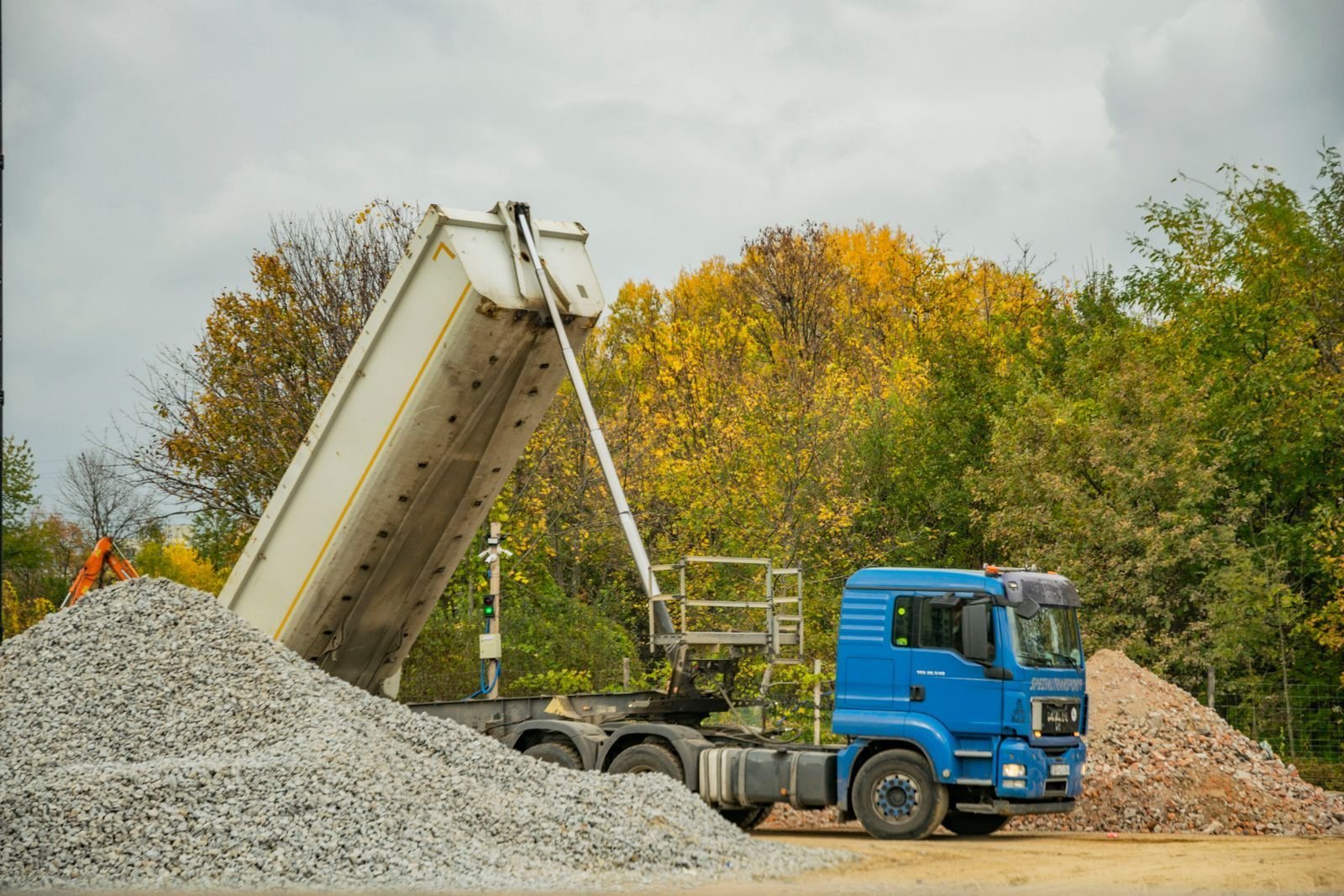
Bulk has its own rules, and they are worth knowing before the truck arrives. Most yards run a minimum load of several tons, and small orders below that minimum often carry a surcharge that doubles the effective price per ton. Delivery is usually billed separately at 50 to 150 dollars per load depending on distance, and the truck needs about 12 feet of width and 14 feet of overhead clearance to reach your pile. Tell the supplier where the pile should go, confirm whether tailgate spreading is included, and check the scale ticket on arrival, because wet stone weighs more and a ton bought by weight after heavy rain contains less actual stone than a dry ton.
Cost: From Quantity to Budget
Once you know the tons, the budget follows from three numbers: the price per ton, the delivery fee, and any extras such as fabric and edging. Common crushed stone and crusher run typically cost 25 to 75 dollars per ton depending on the stone type, region, and haul distance, with limestone and crusher run at the cheaper end and granite and decorative sizes higher. Pea gravel and river rock usually cost more per ton than plain crushed stone, and bagged stone from a home improvement store costs several times the bulk price. These are material prices only, so confirm whether the quote includes tax before you compare two yards.
A worked budget keeps the numbers honest. The 9.2 ton driveway order from earlier, at 40 dollars per ton, costs 368 dollars for stone, plus a delivery fee of perhaps 75 dollars, plus fabric and edging at roughly 50 dollars, for a total near 500 dollars. That total is for a single top layer on an existing sound base, and a full new driveway with a base course can easily double it. Call two or three local quarries for competing quotes, and ask each one the same questions, so the prices you compare are for the same stone, the same unit, and the same delivery terms.
What to Tell Your Supplier
A supplier can only load what you describe, so give them the full specification in one clear message. State the product by name and size code, such as washed #57 stone or crusher run, rather than just saying gravel, because the same word means different products at different yards. State the quantity in both tons and cubic yards, so a unit mix-up cannot silently change your order, and state the density you used if you calculated in tons. Then confirm the delivery details: the date, the drop location, the access width, and whether the price includes delivery and tax.
Ask four questions before you hang up, and the answers will prevent most delivery day surprises. Ask whether the stone is washed or unwashed, because unwashed stone carries dust that clogs French drains. Ask what the minimum load is, and whether a small order carries a surcharge. Ask whether the truck can tailgate spread or only dump in a pile, since spreading by hand from a single pile takes hours. Ask what happens if the truck cannot access the site, because a failed delivery still costs a call-out fee at many yards.
Mistakes That Cost a Second Delivery
The single most expensive error is confusing tons with cubic yards, and it deserves repeating because it happens constantly. A cubic yard of crushed stone weighs about 1.4 tons, so 10 yards is 14 tons, and ordering 10 tons when you needed 10 yards leaves you about 30 percent short before you spread a single shovel. Always confirm which unit the quote and the calculator are using before you call the yard, and state both units in your order. The second error is typing inches as feet, which throws the calculation off by a factor of twelve, and the third is using one density for every stone, which can cost five tons on a 25 ton order.
Three quieter mistakes round out the list, and each one is easy to avoid once you know it. Skipping the sub-base on soft ground means the stone sinks into mud and needs topping up every season, which is a quantity problem caused by preparation, not by math. Forgetting drainage means ruts and ponding return after every storm, and no extra tonnage fixes a surface that holds water. Ordering by area without depth, such as telling a supplier you need stone for 200 square feet, is meaningless to them, because 200 square feet at 2 inches and at 6 inches differ by a factor of three. Give the supplier area, depth, and the resulting yards and tons, and the order will be right.
Top-Up Math for an Existing Surface
Topping up an existing surface uses the same formula with one adjustment: measure only the gap between the current surface and your target grade, not the full structural depth. If your driveway has settled by an inch, you need one inch of new stone, not four, and that single adjustment often cuts the order in half. Measure the gap in five or six spots and average them, since settlement is never even, and add the usual 10 percent buffer for edge losses. A typical top-up runs 1 to 2 inches deep, which for a 12 by 40 foot driveway means about 1.5 to 3 cubic yards, or roughly 2 to 4 tons of #57 stone.
Top-ups also have a rhythm worth planning for, because gravel surfaces lose material every year to tires, rain, and snow removal. Most driveways need a light top-up every two to four years, roughly a ton per 100 square feet at 2 inches, and paths need less. Keeping a small pile of the same stone on hand makes these top-ups a one hour job instead of a delivery event. If you find yourself topping up every year, the problem is usually the base or the drainage, not the quantity, and fixing those will save more stone than any calculator ever will.
Frequently Asked Questions
How much gravel do I need for a driveway?
A typical 12 by 40 foot driveway with a 4 inch top layer needs about 5.9 cubic yards, or 8.4 tons of crushed stone #57 before waste, and about 9.2 tons with the standard 10 percent buffer. A full layered driveway with a 4 inch crusher run base plus a 2 to 3 inch top layer needs roughly 20 to 28 tons for the same footprint. Run your exact dimensions through our gravel calculator to get the number for your driveway rather than guessing from this example.
How many tons of gravel are in a cubic yard?
About 1.3 to 1.8 tons, depending on the stone, with most crushed stone near 1.4 tons per cubic yard. Pea gravel sits near 1.3 tons per yard, general gravel and #57 stone near 1.42, and crusher run near 1.82, because its fines fill the air gaps. Always confirm the density with your supplier, since quarry source and moisture move the real number a few percent either way.
How many cubic yards are in a ton of gravel?
About 0.7 cubic yards for most crushed stone, since one ton divided by 1.42 tons per yard gives 0.70 yards. For pea gravel the figure is closer to 0.77 yards per ton, and for crusher run it drops to about 0.55 yards per ton. The conversion always runs through density, so a single yards per ton figure without a named stone is only an approximation.
How much area does a ton of gravel cover?
One ton of #57 stone covers about 57 square feet at 4 inches deep, about 76 square feet at 3 inches, and about 114 square feet at 2 inches. The easy rule of thumb is one ton per 100 square feet at 2 inches deep, which suppliers quote constantly because it is conservative and easy to do in your head. Use the coverage table above for the full depth grid, and use the calculator for the exact number.
How deep should gravel be for a driveway?
Four inches of compacted stone is the minimum for a residential driveway carrying passenger cars on firm soil. Six inches handles regular traffic, delivery trucks, and clay subgrade much better, and a full new build over soft ground usually runs 8 to 12 inches across two or three layers. Always measure the finished compacted depth, not the loose pile the truck dumps, because compaction shrinks the layer by 10 to 25 percent.
Is gravel sold by the ton or the yard?
Most bulk suppliers sell by the ton, but some sell by the cubic yard, and the unit varies by region and by yard. Always ask which unit the quote uses, and state your order in both tons and cubic yards, so a unit mix-up cannot change your order. Bagged stone from a home improvement store is sold by weight, usually in 50 pound bags, which is a different pricing world from bulk entirely.
Do I need landscape fabric under gravel?
Yes for driveways, paths, and patios, and it is cheap insurance on any surface that will carry weight. The fabric, also called geotextile, keeps the stone and the soil apart, which stops the stone sinking into mud and stops weeds pushing through from below. Overlap the seams by at least a foot, and use a woven fabric under driveways, where strength matters more than drainage.
How much extra gravel should I order?
Ten percent is the standard buffer for most projects, covering spillage, uneven subgrade, and compaction shrinkage. Raise it to 15 percent on sloped or irregular ground, and to 15 to 25 percent for a compacted crusher run base layer, where compaction alone eats that much volume. The buffer costs far less than a second delivery fee, and any small excess becomes your first top-up supply.
How do I calculate gravel for an irregular shape?
Split the shape into rectangles and triangles, calculate each piece with the standard formula, and add the results together. For a curved bed, approximate the curve with a series of rectangles, or measure the average width at several points along the curve and multiply by the length. Measure depth in five or six spots and average the readings, because real ground is never flat, and add the usual waste buffer to the total.